

How to Bleed a Radiator: A Complete Step-by-Step Guide
If your central heating isn’t working well, you may need to bleed your radiators.
It’s a relatively straightforward DIY task that you can do yourself.
But first, you need to establish whether you need to.
And it helps to understand why you’re doing it, too!
Why bleed your radiators?
Bleeding your radiators helps to remove air which is trapped in your central heating system.
When air is present, the system is less efficient because there is less space for hot water.
So, it will cost more for you to heat your home and it’s less environmentally-friendly.
Keeping tenants warm
If you're a landlord and a tenant reports cold radiators, landlord boiler cover means you're not scrambling for an engineer each time.
Common signs that your radiator needs bleeding
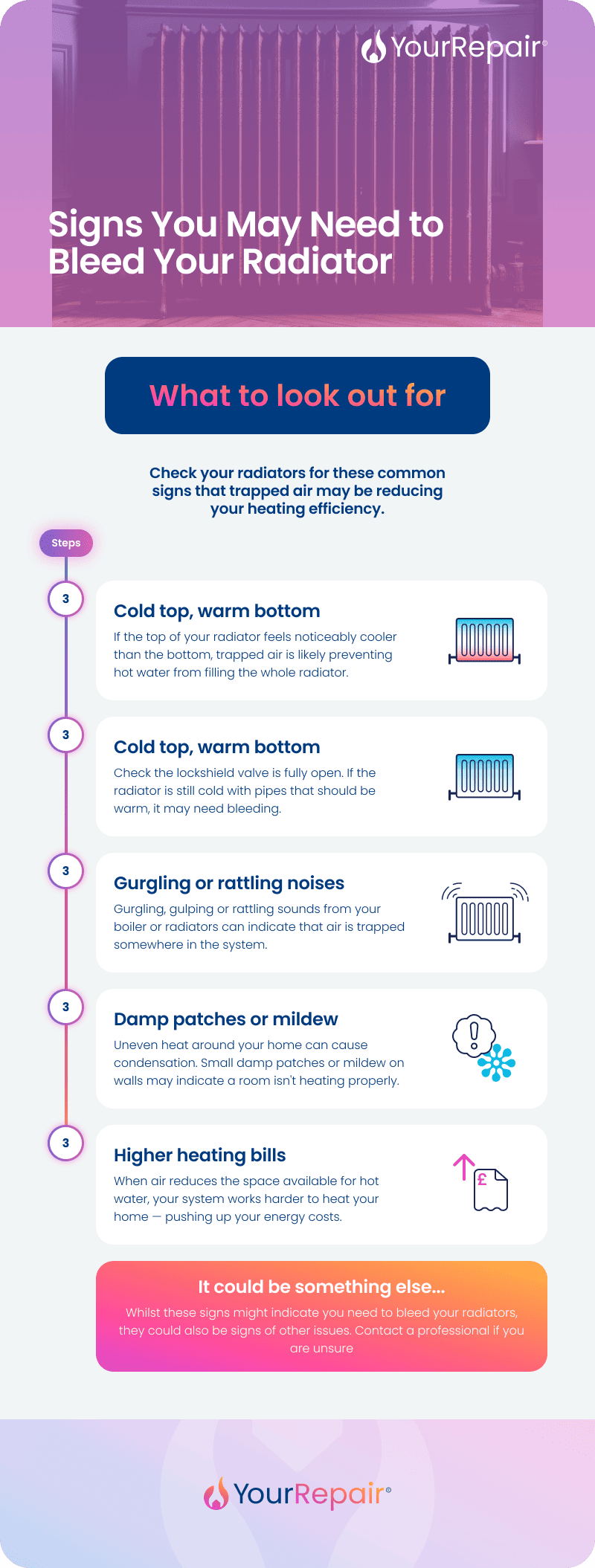
1. The top of the radiator is cold
Turn your central heating on and wait for it to warm up. Then check your radiators.
Does the temperature at the top of your radiators feel the same as the temperature at the bottom of them?
If it’s cold (or just slightly warm) at the top of the radiator, it likely needs to be bled.
2. The entire radiator is cold
First, check that the lockshield valve is open by turning it as far as you can anti-clockwise.
Next, check the pipes going into the radiator by placing your hand on them.
If this has resolved the issue, one of the pipes should start to feel warm.
3. Check thermostat valve
If this hasn’t helped, check the thermostatic valve is moving properly.
Take the cap off the thermostatic valve and push the pin down. This should be moving freely.
If it’s stuck and not moving freely you may need a replacement thermostatic valve.
4. Mildew on the walls
Unbalanced heat around the home can cause condensation.
So, check your home for small damp patches or mildew on the walls.
It could be an indication that the room where they appear in your home is too cold.
(However, note: mildew might have other causes, too.)
Boiler, Radiators, & More with central heating cover Get Covered
5. Strange noises from your heating
Does your boiler make noises similar to gurgling, gulping and rattling?
This can be a sign that air is trapped in the system although it could also be an indication of various other issues too.
Checking your radiators to make sure the problem is not more serious.
How to bleed a radiator system
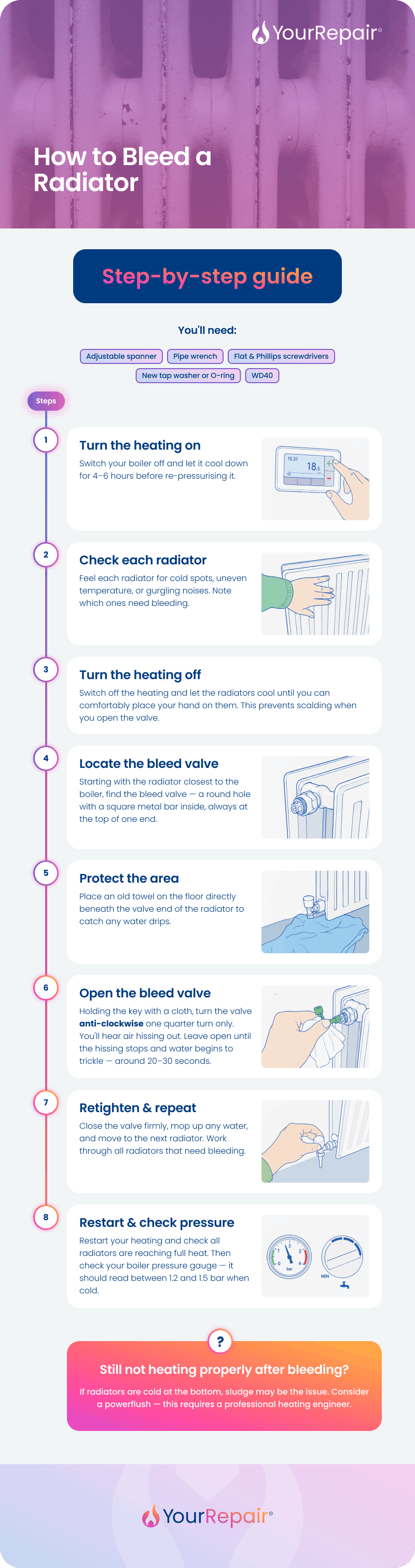
Step 1: Gather your equipment
To bleed your radiators, you will need;
- A radiator key. The bleed valve keys – usually with a square hole - are supplied with the radiator, but you can buy them at a DIY shop. Some modern radiators have a new style of valve that can be turned with a flathead screwdriver.
- A cloth to hold against the open valve
- An old towel for protecting the floor
- A container (to catch any sizeable water leak).
Step 2: Turn the system on
Start up your heating system.
On each radiator, turn the integral thermostatic valves to their highest setting.
Wait until the whole system has had time to warm up and the water is flowing through it.
Step 3: Touch the radiators
You need the system to be warm to be able to identify which radiators need bleeding.
Bear in mind that they may be hot to the touch. Go around and feel the condition of each of your radiators.
Check if any of your radiators are:
- Cool to the touch
- Have a top section that is significantly cooler than the bottom part
- Making gurgling noises.
Step 4: Turn the heating off
Turn the heating off.
This means at the boiler - you don't need to turn the radiators off because you need their control valves remain open.
(If you close them, you isolate the radiator from the rest of the system. This stops the trapped air and water inside escaping properly through the bleed valve.)
Allow your radiators to cool to the point where you can place your hand on them without any discomfort at all.
This is to avoid scalding when you open the valve.
Step 5: Locate the bleed valve
Starting with a radiator closest to the boiler, locate the first bleed screw.
(This is because air tends to accumulate further from the boiler, so working outward ensures even bleeding.)
This is always at the top of a radiator and located at one end.
It looks like a round hole with a square metal bar inside it.
The square section is used to drive a threaded section that forms the valve.
Boiler, Radiators, & More with central heating cover Get Covered
Step 6: Protect the area
By undoing the bleed valve, air – and possibly some water – will be released.
So, to protect your carpets and floors, place an old towel on the floor.
It should cover the area directly under the valve end of the radiator.
Step 7: Loosen the valve
Holding the radiator key with the cloth for protection (against hot water), place the square bit fully over the bleed valve.
(Or, if you’re using a flathead screwdriver, put the blade into the groove.)
Turn it anti-clockwise one-quarter of a turn only.
This should be sufficient to let trapped air get out but without a huge flow of water.
The air should make a whistling sound as it comes out.
Any water should be caught by the cloth and will drip onto the old towel.
Leave the valve open with the key still in place until the whistling stops. It may take 20 to 30 seconds.
Retighten the valve and mop-up any water on the radiator or floor. Move on to the next radiator.
Step 8: Restart the system
With each radiator checked in the same way, recheck that all bleed screws are fully tight.
Once that is done, restart your heating system and allow it to warm up.
Once warm, go around each radiator again and check that they are reaching full heat.
When you are happy with the heat, turn down the thermostatic valves as appropriate.
If some radiators are still heating unevenly, the system may need balancing.
This is an adjustment of the flow of water to each radiator (unlike bleeding, which is the removal of trapped air).
Step 9: Check boiler pressure
You also need to check that your boiler is operating at the right pressure.
By bleeding your radiators and releasing excess air, you may have lowered the overall pressure of your system.
So look at the gauge on your boiler (if you have one) to see if it’s between 1.2 and 1.5 bars of pressure when it's cold.
If it’s below 1.2, you need re-pressureise your boiler. This will likely require a heating engineer.
Consider a powerflush
If bleeding doesn’t resolve your radiator’s issue, you should consider a power flush for it.
This is a more extensive pipe-clearing process that focuses on clearing sludge rather than air.
It requires the help of a professional.
Central heating cover from YourRepair
Unexpected heating breakdowns can happen. Get protected today with central heating cover from YourRepair. T&Cs apply.