

How to Keep Your Home Warm — and Reduce Your Heating Bills at the Same Time
A cold home can cost you more money than you think.
It can also cost you in more ways than you think
Read on to learn about keeping your home warm and optimising your system with the latest building science.
Reasons to keep your house warm
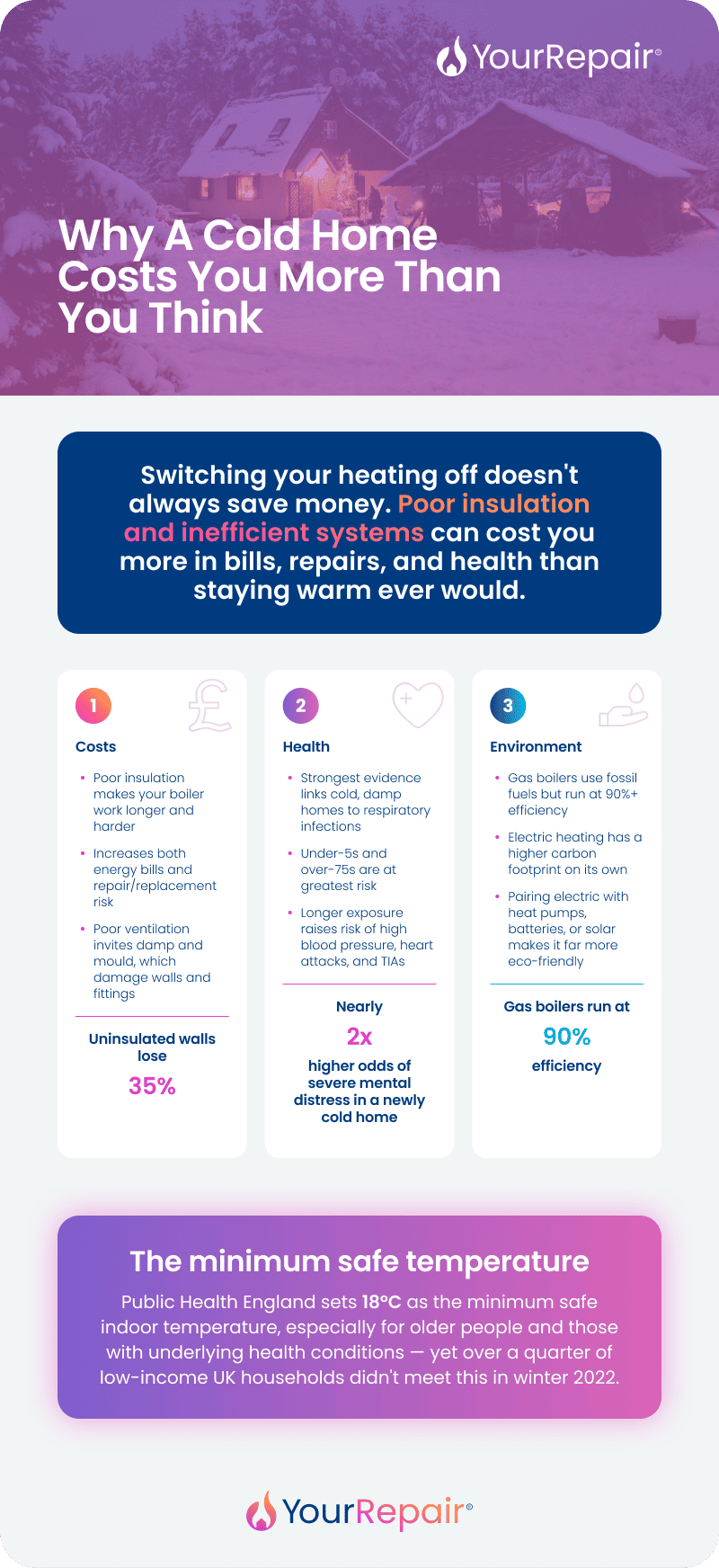
1. Costs
Many associate a cold home with saving money on energy bills.
This is largely true if your heating is simply switched off. But not if your home is losing heat for other reasons.
Poor insulation and inefficient heating systems make your boiler work longer and harder.
This increases your bills and the chances of your boiler not working (i.e., more repair and replacement costs).
And, when poorly ventilated, cold homes can also be more prone to condensation, damp, and mould.
These can cause lasting damage to walls, ceilings, and fittings, as well as expensive repair bills.
2. Health
Physically, the strongest evidence links cold and damp homes to respiratory infections. Children under five and the elderly (over 75) are at greatest risk.
Longer-term exposure raises the risk of high blood pressure, heart attacks, and transient ischaemic attacks.
And data from the UK Household Longitudinal Study suggested moving into a cold home is associated with:
- Nearly double the odds of severe mental distress for people with no prior mental health issues
- Over three times the odds for those already on the borderline.
3. Environment
There are several ways to keep your home warm. Each has a different level of impact on the environment.
Gas-powered boilers, for example, use fossil fuels but are highly (90%+) efficient. Electric powered heating systems generally have a higher carbon footprint.
But when paired with heat pumps, home batteries, and solar panels, they become much more eco-friendly.
Either way, an efficient home will still require less gas or electricity from the grid.
What is the optimal temperature?
Public Health England sets 18°C as the minimum safe indoor temperature.
This particularly suits older people and those with underlying health conditions.
Over a quarter of low-income UK households failed to meet in winter 2022.
Read: How to Balance Your Radiators: A Step-by-Step Guide (With the Mistakes to Avoid)
Tips for keeping your home warm
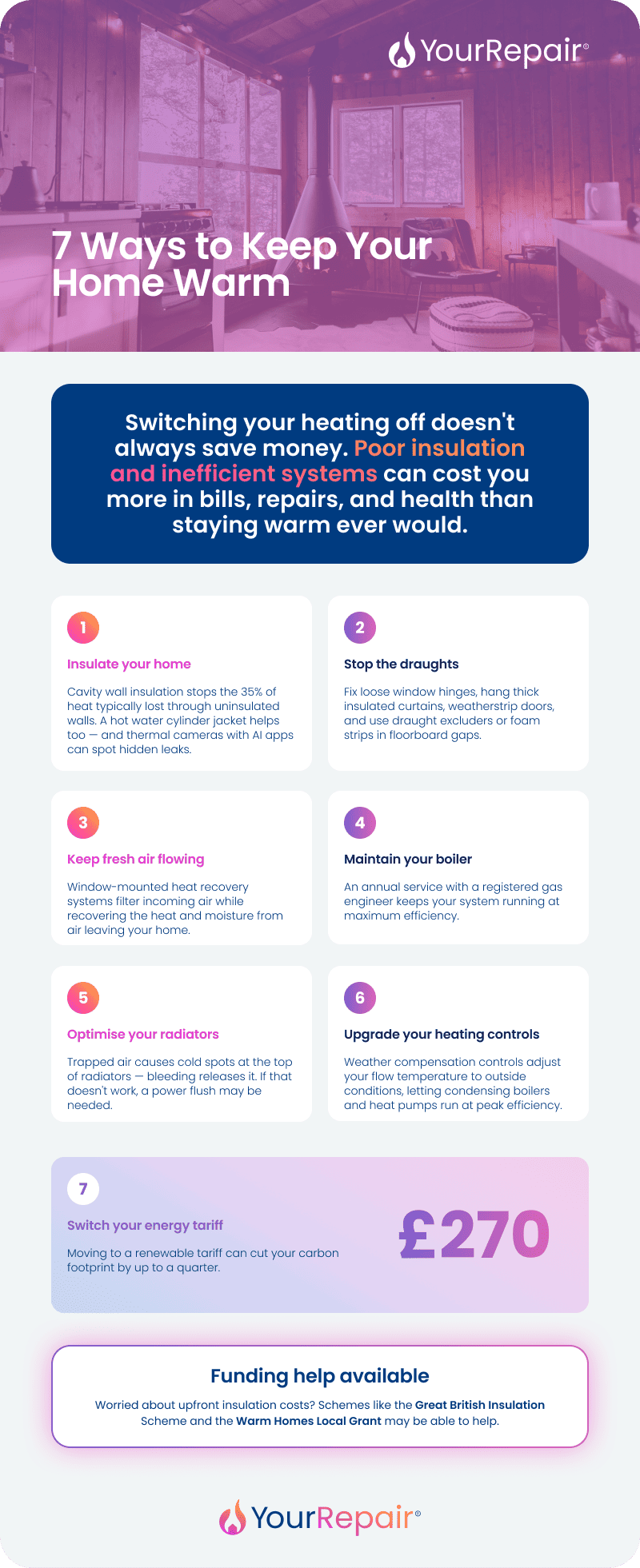
1. Insulate your home
Insulation is one of the easiest ways to keep your home warm all year round.
Meanwhile, cavity wall insulation prevents the 35% of heat that is typically lost through uninsulated walls.
If you have a conventional boiler with a hot water cylinder, it might be leaking heat.
Fitting a relatively cheap hot water cylinder jacket helps retain heat for longer and saves the energy required to reheat water.
To take this a step further, you can use affordable thermal cameras paired with AI apps and smart thermostats.
These can precisely diagnose hidden thermal leaks in your home.
If you are concerned about the upfront costs, look into funding options.
Two exike the Great British Insulation Scheme or the Warm Homes Local Grant.
2. Stop the draughts
Identify problem areas in your home where hot air escapes.
Adjust any loose window hinges, and consider putting up thick, insulated curtains.
Weather strip your doors and use draught excluders on the bottom.
You can also force foam strips into the gaps of exposed wooden floorboards to prevent air from sneaking in.
3. Keep the fresh air flowing
To bring in fresh air without losing your hard-earned heat, consider modern window-mounted heat recovery systems.
These compact units filter incoming air while recovering heat and moisture from the air leaving your home.
4. Maintain your boiler
An annual boiler service helps maintain maximum efficiency.
Schedule a service with a registered gas engineer.
Most can work with all types of boilers, but be sure to check what yours is before contacting them.
5. Optimise your radiators
From time to time, air can get trapped inside your radiators.
This prevents hot water from circulating properly, often causing cold spots at the top of the radiator.
Bleeding your radiators will release this trapped air and get them back to their best in no time.
If this doesn’t work, then you may need to consider a power flush.
6. Upgrade your heating controls
A high-performance home relies heavily on how the entire system is controlled.
To move beyond basic efficiency, you should implement weather compensation controls.
This intelligently adjusts your system's flow temperature based on outside weather conditions.
It allows condensing boilers (the most common type of boiler) and heat pumps to run at peak efficiency.
7. Switch your energy tariff
If you haven't reviewed your energy supplier recently, consider switching to a renewable energy tariff.
This simple switch can slash your carbon footprint by up to a quarter.
It could also potentially save you up to £270 annually.
Prepare for freezing conditions (in the UK)
Check the exterior of your home
The outside of your home needs regular attention too.
Clear any build-up of leaves, moss, or debris from your gutters to prevent roof leaks.
Use a hosepipe to wash away residue, and fit covers over your drain holes to stop future blockages.
Make sure to repair any existing roof leaks and cut away tree branches that could fall during heavy winds.
Emergency preparations
If a severe freeze is forecasted, take additional steps to ensure your family's safety.
Stock up on rock salt to melt ice on driveways, and ensure you have a sufficient supply of heating fuel.
Leaving your water running at a trickle can prevent pipes from freezing up.
You should also locate your mains water supply via the stopcock just in case a leak does occur.
Vehicle and equipment safety
Have a mechanic check your car's antifreeze, oil, wiper blades, and tyres.
Keep warm clothes and blankets in your vehicle in case of an emergency.
Finally, ensure all fuel-burning equipment in the home is adequately vented and kept clear.
Affordable boiler & heating cover
Regardless of how well you maintain your system, breakdowns happen.
Having home emergency cover can save you money by providing:
- Unlimited call outs
- Free parts and labour
- A free annual boiler service.
Central heating cover from YourRepair
Unexpected heating breakdowns can happen. Get protected today with central heating cover from YourRepair. T&Cs apply.