

What Is Central Heating Cover?
Heating and hot water typically make up over half of a UK household's energy bill (Energy Saving Trust).
This is roughly £80-100 a month for an average home.
However, an inefficient system can mean these figures are higher than they need to be.
And unpredictable repair bills can add big extra costs.
This is why many choose to get heating cover.
Central heating cover: An overview
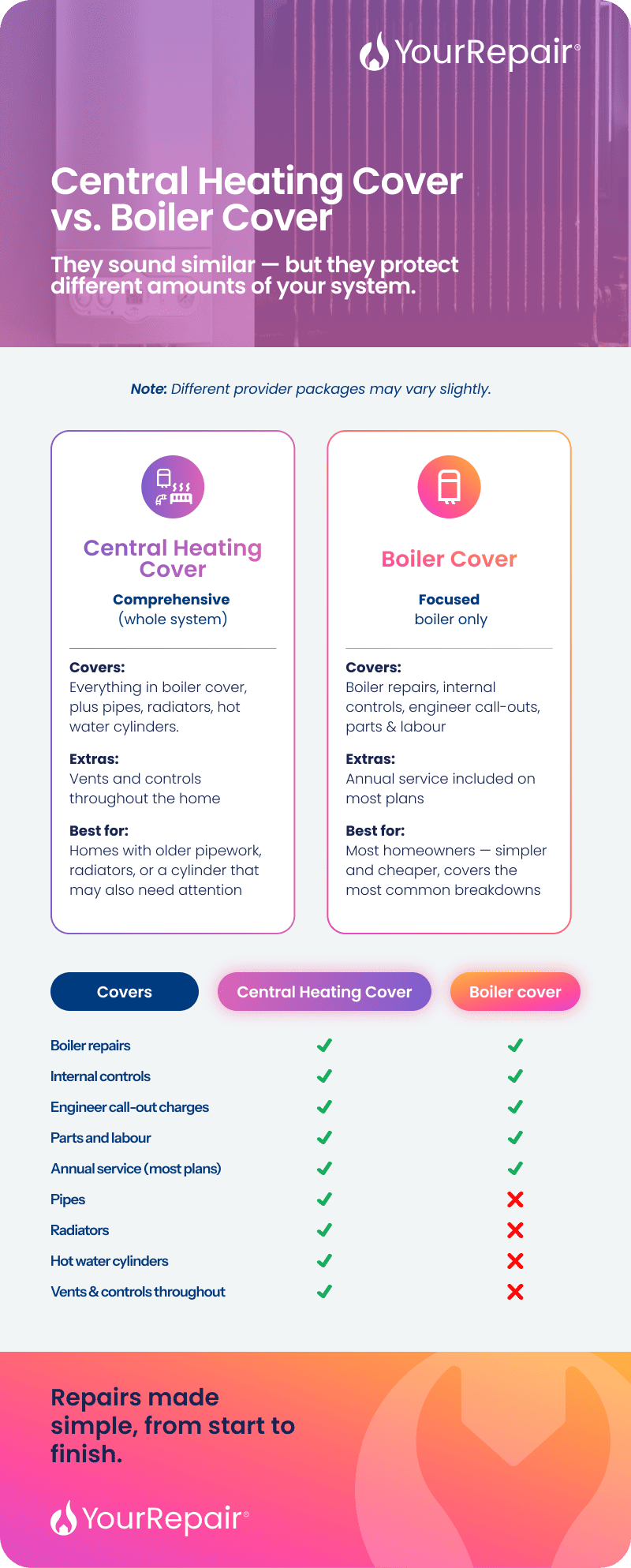
Central heating cover is a full service, maintenance and repair plan for your whole heating system.
Boiler cover only covers the boiler itself. Central heating cover looks at your whole system.
It covers a breakdown or fault in any of these parts:
- The boiler or heat pump
- Radiators
- The hot water cylinder
- Water tanks
- Heating controls and programmers.
Further reading: What is Boiler Cover? A Complete Guide for UK Homeowners
Is central heating cover worth it?
Central heating cover provides peace of mind. It helps you avoid:
- Unexpected repair costs
- Reduced chances of losing heating for a long period
- Reduced chances of sharply rising energy bills.
Here’s what to weigh up.
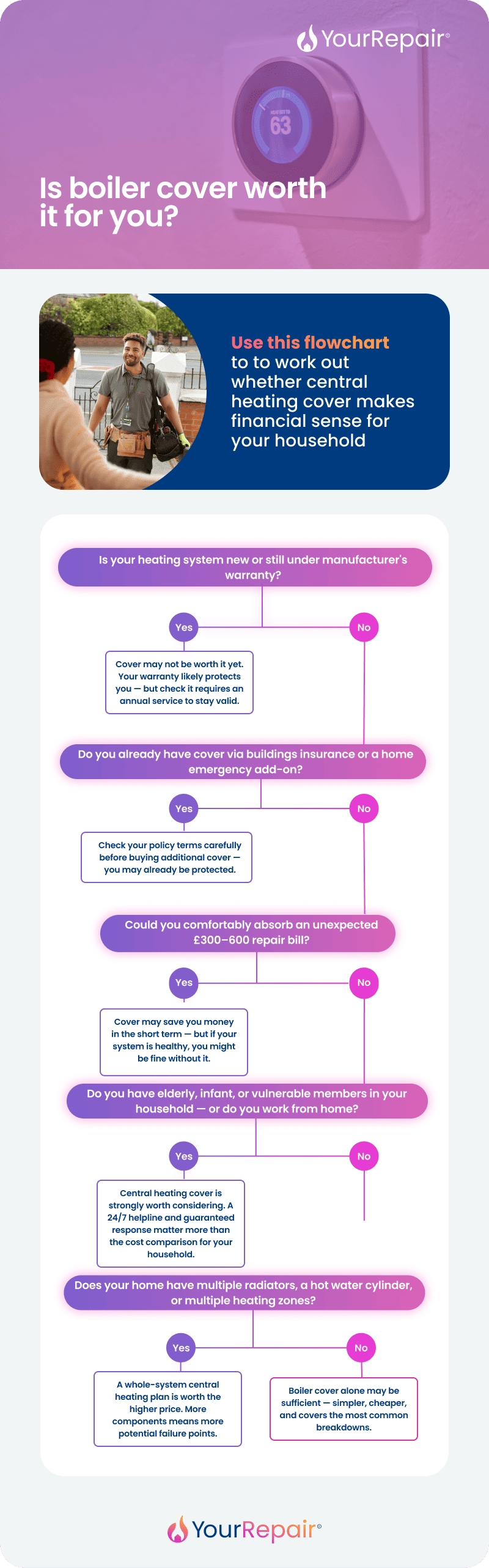
1. Age, condition & warranty of your system
This is the biggest factor. A newer system — especially one still under warranty — is far less likely to break down.
Cover on a system like this is more likely to be pure cost, with no payout.
Older systems carry real breakdown risk, especially once their warranty has run out.
That's where cover starts to earn its keep.
So, before you take out a new policy, check what your existing warranty covers. There's no point paying twice.
2. Your financial buffer
Could you cover an unexpected £300-600 repair bill without it causing real strain?
If a bill like that would really hurt your finances, a fixed monthly cost buys you certainty.
If it wouldn't, and your system is new and healthy, skipping cover might save you money.
3. What you already have covered
Your heating might already be covered by:
- Buildings insurance
- A manufacturer warranty
- A home emergency add-on.
Always check these first before assuming you need a new policy.
4. The potential impact of lost heating
Households with infant, elderly or vulnerable members will be harder hit than others.
It may disrupt some people more than others for different reasons, too.
For example, people who work from home will notice it more.
For these households, a 24/7 helpline and a guaranteed response matter more than the pure cost comparison.
5. The complexity of your system
Having more heating components (radiators, a hot water cylinder, multiple heating zones, etc.) means more potential failure points.
The more complex your system, the more a whole-system plan is worth its higher price.
How to Bleed a Radiator: A Complete Step-by-Step Guide
6. Whether you already have a trusted engineer
If you've already got a reliable local heating engineer on speed-dial, cover could matter less to you than it would to someone starting from scratch.
Costs of central heating cover
Central heating cover usually costs between £15-25 a month. Your exact price might vary depending on:
- The age of your system
- How many components are covered
- Your excess level.
On top of this, you might still pay a call-out fee when you make a claim (more on that below).
Boiler, Radiators, & More with central heating cover Get Covered
Consumer choice
There are tens of different central heating providers across the UK to chose from.
Approximately 15 - 20 of these are nationwide providers, and many more are smaller, regional ones.
Many also offer other types of cover (boiler, home emergency, plumbing & drainage, etc.). And each has its own prices and policies.
What to look out for in heating cover
What's included in your central heating cover may vary between providers.
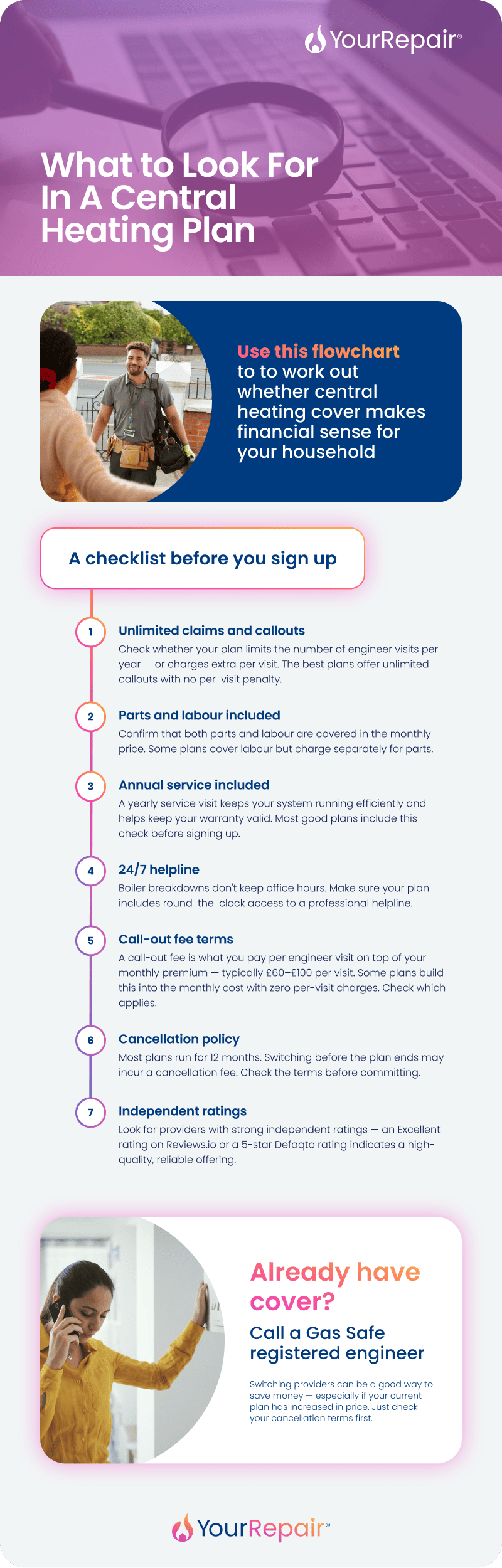
Whatever heating you have, look for cover that includes:
- Unlimited claims and callouts each year
- All repairs to your central heating, including the boiler or heat pump, with parts and labour covered in the monthly price you pay
- A yearly service to check everything is running well
- A 24/7 helpline to receive professional assistance.
Pay attention to the number of call-outs your plan allows. Some limit the number or charge extra per visit. Others offer unlimited call-outs.
Call-out fees
A call-out fee is what you pay towards each engineer visit. It's agreed upfront when you sign-up.
Usually, this falls into the £60 to £100 price bracket per call-out.
Some packages include this in the monthly price instead.
Annual services
Homeowners can do some basic heating maintenance themselves.
But an annual service visit is the best way to keep your heating in good shape.
Most heating cover packages include these. They also help keep your warranty valid.
A Gas Safe Engineer checks your whole heating system to catch problems early.
Switching heating cover providers
Switching providers is often a good way to save money.
Watch for cancellation fees if you switch before your plan ends (most run for 12 months).
Special circumstances
Renters and landlords
If you're a tenant, heating cover for your home is your landlord's responsibility.
Whether you're a landlord or homeowner, check your buildings insurance first. Cover might already be included.
Communal heating systems
If you live in a flat or housing estate, you may be on a district heat network.
In communal heating systems, maintenance is generally handled centrally.
But tenants should know these networks have recently seen sharp, unexpected cost rises.
Warranty overlap
Your heating system could also still be under warranty.
Warranties often won't cover breakdowns caused by another part of your system.
For example, poor water quality can lead to corrosion in both traditional boilers and modern heat pump wet systems. Experts are increasingly tackling this with chemical-free water treatment.
Boiler, Radiators, & More with central heating cover Get Covered
The bigger picture
Efficiency and whole-system thinking
Many homeowners are unaware that a boiler's rated efficiency doesn't always match its real-world performance.
Some modern boilers are also held back by outdated controls. This traps them in wasteful on-off cycles.
But a boiler is only one part of a wider system: pipes, radiators, a hot water cylinder, and controls that tie it all together.
Ask 'is the whole system working well?' instead of just, to 'is it efficient?'
A whole-system plan helps engineers keep your system — rather than just your boiler — running efficiently.
It costs more upfront, but in the longer term, it could significantly cut your energy bills.
Water treatment: VDI 2035
Over time, rust corrodes central heating system pipes, causing the wider system to lose efficiency.
Traditionally, the UK heating industry has relied on adding chemicals into systems to prevent this.
However, engineers are now moving toward a German standard called VDI 2035.
It sets water-quality targets related to hardness, conductivity and pH.
Engineers meet these targets in a number of ways.
For example, by purifying water before it enters your heating system.
This removes minerals and oxygen to stop rust and limescale from causing damage.
Read: Power Flush for Central Heating: How It Works & How Long It Takes
The changing energy grid
As the UK moves away from fossil fuels, more heating options are emerging beyond gas and oil boilers.
Heat pumps and Zero Emission Boilers (ZEBs) are two examples of alternatives.
Central heating cover from YourRepair
Unexpected heating breakdowns can happen. Get protected today with central heating cover from YourRepair. T&Cs apply.