

Landlord Boiler Cover: What's Included, Costs & How to Choose
Boiler problems cause more disruption than many homeowners expect.
Research by Which? found that 75% of households with older heating systems are unprepared for a breakdown.
For landlords, the stakes are even higher. A broken boiler isn't just an inconvenience — it's a legal liability.
Under the Landlord and Tenant Act 1985, landlords are obligated to keep heating and hot water working in their properties.
Ignoring this duty can lead to strict council enforcement, heavy fines, or expensive tenant compensation claims.
So, understanding what landlord boiler cover is - and choosing the right provider - can make all the difference.
What landlord boiler cover costs and includes
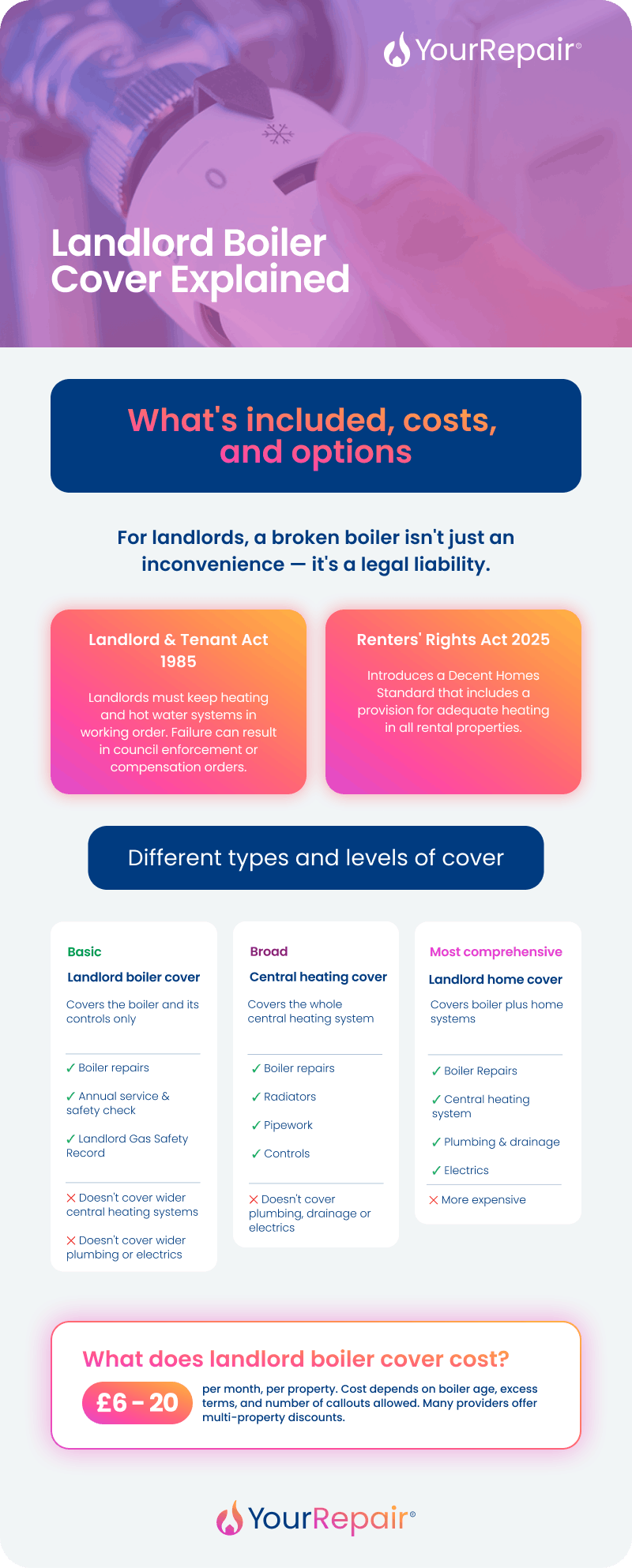
Landlord boiler cover typically costs £6–£20 per month, per property.
However, the exact price can depend on several factors, such as:
- The age of the boiler
- The excess terms you select
- The number of allowed engineer call-outs.
For a monthly fee, landlord boiler cover protects your boiler and limits repair costs when things go wrong. A standard policy usually includes:
- Boiler & controls repairs: Coverage for sudden failures of your boiler and its thermostat/controls
- 24/7 engineer access: The right to call out qualified engineers, usually via a dedicated customer helpline
- Parts & labour costs: Help with paying for the engineer's labour and any new parts required to complete the repair
- Annual servicing & inspection: A professional yearly boiler service and safety check.
The economics of preventative maintenance
To understand the financial return of boiler cover, it helps to compare these predictable monthly payments against the standalone costs of emergency call-outs:
- A standalone Gas Safety check (CP12) typically costs £60 to £100 on its own
- An annual boiler service runs between £80 and £120
- A complete boiler replacement averages between £1,500 and £3,000 fully installed
- A proactive pre-tenancy plumbing and heating inspection costs £80 to £150
- A single out-of-hours winter emergency call-out can easily clear £300 before any actual repair work even begins.
Keep your properties protected with Landlord Boiler Cover Get Covered
Safety check vs. boiler Service: Clearing up the confusion
Landlords often mistake an annual boiler service for a Gas Safety check (CP12). But they are different tasks.
- The Gas Safety Check (CP12): This is a strict annual legal requirement under the Gas Safety Regulations 1998. A Gas Safe registered engineer must inspect your property's gas appliances and flues to verify that they are safe. It does not involve cleaning or repairing the boiler - it is simply a safety assessment
- The boiler service: This is an active, preventative maintenance job. The engineer inspects, cleans, and services the boiler's components to ensure it runs efficiently and to identify faults before they worsen.
Pro tip: The two-month renewal window
Up until April 2018, a Gas Safety Certificate lasted for exactly 12 months from the date of the inspection.
This forced many landlords to schedule checks every 10 or 11 months to ensure there was never a gap in coverage, costing them more money over time.
The rules have now been changed. Any Gas Safety check carried out within the last two months of your current certificate's validity is treated as if it were performed on the exact expiry day of that current certificate.
This allows you to secure your compliance documentation early without losing a day of your previous certificate’s coverage.
Tightening legal pressures: Renters' Rights & Awaab's Law
The legal landscape for UK landlords is changing.
The Renters' Rights Act 2025, which came into force on 1 May 2026, reinforces a landlord's safety responsibilities. It introduced the Decent Homes Standard to the private rented sector, which includes a provision for adequate heating.
Furthermore, activists and MPs are actively demanding the immediate rollout of Awaab’s Law to private landlords.
Originally designed for social housing, Awaab’s Law introduces legally binding timescales for landlords to resolve serious hazards like damp, mould, or heating failures.
Under these upcoming rules, private landlords who fail to meet rapid repair deadlines face severe consequences, including:
- Heavy local authority fines
- Banning orders
- Tenant-led compensation claims through the ombudsman of up to £25,000.
Having a landlord boiler cover plan with engineer access can act as a vital shield against these liabilities.
Keep your properties protected with Landlord Boiler Cover Get Covered
The tenant access roadmap: Handling refusals legally
Gas and heating safety are strictly the landlord's legal responsibility.
However, you cannot simply give up if a tenant refuses to let an engineer into the property.
Besides, landlords are never allowed to gain access by force except in extreme, life-threatening emergencies.
If you are struggling to gain access for mandatory safety checks or boiler services, you must follow this strict, legally recognized paper trail:
- Provide 24 hours' Notice: You must give the tenant at least 24 hours' notice, and they must agree to the inspection time before you enter.
- Send three recorded letters: If the tenant refuses entry, send a formal letter explaining why the safety checks are legally required. Send it by recorded delivery, giving the tenant 14 days to respond. Repeat this process up to three times to establish a clear audit trail.
- Contact the local council: Ask your local authority to explain to the tenant why the Gas Safety check is vital for their safety. Tenants are often more receptive to advice coming from an official regulatory body.
- Initiate legal action: If the tenant still refuses, consider starting the eviction process with a Section 8 notice or applying directly to the courts for an injunction order to gain access.
Tax planning & Making Tax Digital (MTD) for 2026
UK landlords are already navigating heavy tax burdens.
George Osborne's Section 24 mortgage interest tax hikes, for example. have brought many buy-to-let investors into higher tax bands.
Now, the biggest administrative change to the UK tax system in decades is arriving.
Starting 6 April 2026, under the government's Making Tax Digital (MTD) rules, self-employed business owners and landlords earning above £50,000 in gross rental income (plus any self-employment income, before expenses) must:
- Keep digital records
- Submit quarterly updates using HMRC-approved software. Instead of submitting a single Self-Assessment return once a year, you will be required to submit five returns annually (four quarterly updates plus one final declaration).
This threshold drops to £30,000 from April 2027 and £20,000 from April 2028. This means most landlords will be brought into the system within two years.
This makes predictable expenses highly beneficial. The monthly cost of landlord boiler cover is a fully allowable business expense.
Logging a steady, predictable fee of £6 to £20 per month in your accounting app is significantly easier to report quarterly than a sudden, chaotic £300+ emergency breakdown bill that disrupts your cash flow and complicates your digital record-keeping.
Boiler cover vs. central heating vs. homecare
Before choosing a policy, it is important to select the right scope of coverage for your property:
- Landlord boiler cover: Focuses specifically on the boiler and its controls. It's a targeted simple policy to manage. And it's relatively cheap and easy to claim on. If your primary concern is meeting your basic legal heating obligations, this is your most practical option.
- Central heating cover: Applies to the whole heating system, including the boiler, controls, pipework, and radiators.
- Landlord homecare cover: A much broader type of policy that typically covers your boiler, central heating, plumbing, drainage, and electrical wiring. This may sound appealing, but broader is not always better. However, if your rental property has older plumbing or wiring, a homecare-style policy may be worth the extra cost.
How to choose the right landlord boiler cover

When shopping around for the right landlord boiler cover package, keep this practical checklist in mind:
1. Check whether you already have it covered
Before buying a new policy, check the terms of your existing landlord insurance policy.
Your boiler may already be protected under building and contents cover. You should also check if your heating system is still covered by a manufacturer's warranty or an extended warranty from an approved installer (such as Vaillant Advanced or Worcester Accredited).
However, keep in mind that warranties only cover specific breakdown scenarios within set timeframes. Outside of those, you will pay out of pocket.
2. Consider your boiler's age and make
Many cover providers charge higher monthly rates for boilers over 15 years old, or include special exclusionary terms for pre-existing faults.
(At YourRepair, we provide the same price regardless of your gas boiler's make, model, age, or property type.)
Keep your properties protected with Landlord Boiler Cover Get Covered
Boiler cover for flats and leasehold properties
Most flats have their own self-contained boiler. If this is the case in a flat you let, a standard landlord boiler cover plan applies in the same way it would for a house.
There are exceptions to this setup, such as some older converted buildings or purpose-built blocks with communal heating systems. In these, the freeholder or managing agent is often responsible for the shared boiler, and cover for it may already be included in your service charge.
If you’re unsure which applies to your property, check your lease agreement or contact your managing agent before purchasing cover.
3. Look at excess charges
Excess is the fee you pay towards the cost of getting an engineer out to fix a problem.
A rough guide for an engineer’s visit is around £60.
Some boiler cover packages build this excess directly into their monthly premium, while others bill it separately per call-out.
Pick the option that matches your cash flow comfort.
What ‘no-excess plans’ means
Some landlord boiler cover providers offer no-excess plans. This means you pay nothing towards the cost of an engineer call-out.
These policies charge a higher monthly fee (usually £3 to £5 more per month) than standard excess plans, to make up for the fact that customers never pay anything extra when you claim.
For landlords managing high-turnover properties or multiple tenancies, a no-excess plan can be worth the extra cost. It removes the friction of per-claim charges and makes budgeting more predictable.
However, if your boiler is relatively new and breakdowns are unlikely, a standard plan with a modest excess will usually offer better overall value.
4. Call-out limits & direct tenant access
Check whether the helpline is a 24/7 service and whether claims are unlimited.
Crucially, ensure the policy lets tenants call out engineers directly without needing you on site.
This has a number of advantages, including:
- Speeding up repairs (vital for risks like carbon monoxide leaks)
- Protecting your tenants
- Saving you from sudden stressful emergency calls.
Does landlord insurance cover boiler breakdown?
Standard landlord buildings insurance is designed to cover structural damage, things like:
- Fire
- Flooding
- Accidental impact.
It does not typically cover mechanical or electrical breakdown. So if your property’s boiler breaks down, your policy will not pay out. You will have to pay the cost of a call out, repair or replacement yourself.
However, some landlord insurance policies might include an optional boiler or home emergency add-on. But these tend to offer limited coverage rather than the ongoing protection a dedicated boiler cover plan provides.
In short: landlord insurance protects the building. Landlord boiler cover protects what keeps it habitable.
Futureproofing: The 2030 EPC 'C' mandate
Keeping your heating system running efficiently is no longer just about preventing breakdowns.
Under the government's energy efficiency proposals, all landlords must upgrade their rental properties to a minimum EPC rating of C by 2030 (up from the current minimum of E).
This represents a major hurdle, as currently only 48% of private rented homes in England meet this standard.
To protect landlords from endless upgrading expenses, the government has proposed a maximum cost cap of £15,000 per property. And there's an affordability cap of £10,000 for lower-cost properties.
Starting early with basic fabric insulation and keeping your boiler highly efficient ensures your EPC rating is protected without forcing you into immediate, expensive structural retrofits.
As a major bonus, efficient boilers directly save your tenants an average of £240 annually on their energy bills, boosting tenant satisfaction and rent reliability.
Switching providers hassle-free
Switching landlord boiler cover providers is simple and is one of the easiest ways to make savings.
This is especially useful if you manage multiple properties and can benefit from multi-property discounts.
Most plans run for 12 months, and switching before your current plan expires may incur a cancellation fee, so time your switch wisely.
YourRepair offers comprehensive, nationwide landlord boiler cover plans.
They feature 24/7 engineer access, unlimited claims, and an annual Gas Safety check included in every package.