

Fire Safety Regulations for Landlords: Legal Duties, Fines and Compliance Checklist
A fire doesn't wait for a convenient time to break out.
And unlike a slow leak or a failing boiler, it can create a life-threatening emergency in just seconds.
That's what makes fire safety different from many other items on a landlord's compliance list.
As with gas and electrical safety, fire safety regulations for landlords are some of the most heavily scrutinised legal requirements in the private rented sector.
For good reason, too: Get it wrong and the consequences can be immediate and irreversible.
Fire safety is a core legal obligation for landlords
Fires kill around 250 - 300 people a year on average in Great Britain. Most of these deaths are a result of smoke inhalation rather than burns.
There are several areas in properties that can lead to an increased likelihood of death or injury from fires, including:
- Faulty equipment or wiring
- Blocked escape routes
- Poor structural protection.
And more.
So, fire safety is not about ticking boxes, it is a direct responsibility for human lives.
The Grenfell Tower fire
The Grenfell Tower fire in 2017, which killed 72 people, remains the defining reminder of what happens when fire safety standards fail.
In the years since the fire, cladding rules have tightened significantly, including a ban on combustible materials in high-rise buildings.
And in 2024, the public inquiry into the tragedy concluded that:
- Every one of those deaths was preventable
- Residents had been let down by those responsible for their safety over many years.
New rules on cladding (an external covering on buildings) were put into place
Keep your properties protected with Landlord Boiler Cover Get Covered
Legal and criminal liability
When it comes to fire safety in rental properties, the stakes are high so the law is strict.
Landlords are legally required to ensure that properties are structurally safe and fitted with appropriate fire detection and suppression systems. If you fail to do this, you face:
- Tenant disputes and severe reputational damage
- Local authority enforcement actions and substantial court-ordered fines
- Banning orders preventing you from letting properties
- Criminal prosecution
- Imprisonment.
Landlords' core fire safety duties
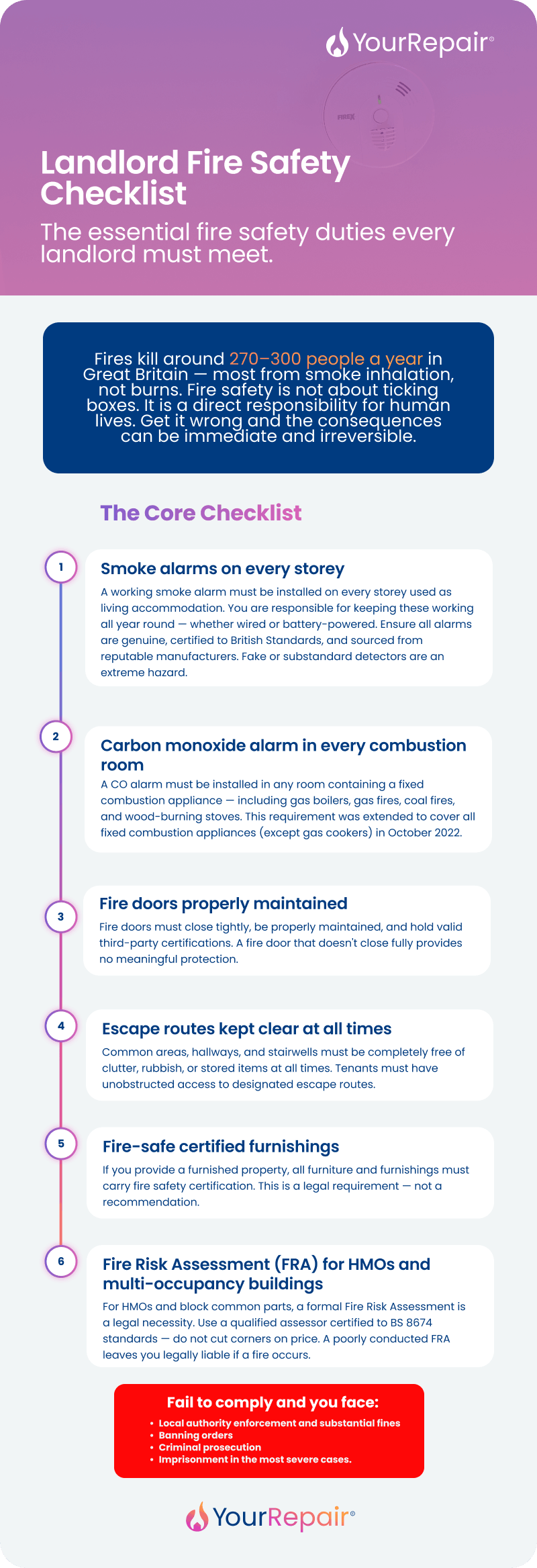
To stay compliant, the law breaks your fire safety obligations down into several clear, ongoing duties.
Below is the essential fire safety checklist that every landlord must implement:
1. Smoke alarms & carbon monoxide detectors
Under statutory guidelines, landlords must install and maintain working alarms to provide early warning in the event of an emergency:
Smoke alarms
You must provide a working smoke alarm on every storey of the property that is used as living accommodation.
There are several different types of smoke alarms. Some are wired into properties, others require batteries. It’s your responsibility to keep these working all year round.
Carbon monoxide (CO) alarms
You must install a carbon monoxide alarm in any room containing a fixed combustion appliance, including:
- Gas boilers
- Gas fires
- Coal fires
- Wood-burning stoves.
Note: this requirement was extended to cover all fixed combustion appliances (other than gas cookers) in October 2022.
A warning against fake equipment
Landlords must ensure all alarms are genuine, certified to British Standards, and sourced from reputable manufacturers.
Substandard or "fake" smoke detectors are an extreme hazard and give tenants a dangerous false sense of security. 2. Fire Risk Assessments (FRAs) & The Competency Standard
For many properties, particularly block common parts and multi-occupancy (HMO) buildings, a formal Fire Risk Assessment (FRA) is a legal necessity.
The importance of competence
British Standard BS 8674 establishes rigorous benchmarks for fire risk assessors. Organizations like FireQual offer formal qualifications to verify that assessors possess the necessary competence to identify hazards.
Why cutting corners costs more
Choosing a fire risk assessor solely on the lowest price rather than qualified competency can compromise safety.
Poorly conducted assessments will likely fail to identify structural risks, leaving you legally liable if a fire occurs.
Keep your properties protected with Landlord Boiler Cover Get Covered
3. Structural and passive fire protection
Structural and passive fire protection measures are designed to contain a fire at its source, allowing tenants time to escape.
Fire doors
You must ensure that fire doors are properly maintained, close tightly, and have valid third-party certifications.
Passive protection & compartmentation
Fire stopping and cavity barriers must be correctly installed by passive fire protection practitioners to prevent smoke and flame spread.
Structural fire engineering
Fire resistance is classified using the REI criteria:
- R represents load-bearing capacity (preventing structural collapse).
- E represents integrity (blocking flames and openings)
- I represents insulation (limiting temperature rise on the non-fire side)
(In the original French: Résistance, Étanchéité, Isolation.)
Using verified fire-protection materials helps ensure concrete, steel, and masonry structures maintain their integrity during a fire. Examples of this include intumescent coatings, sprayed mortars, boards, and more.
4. Safe escape routes & fire-safe furnishings
Landlords must ensure that tenants have unblocked access to designated escape routes at all times. So, common areas, hallways, and stairwells must be free of clutter, rubbish, or stored items.
And if you provide a furnished property, the furniture must be certified fire safe.
High-stakes scenarios: Specific property types
While basic rules apply to all tenancies, certain properties require highly specialized fire safety management.
Houses in Multiple Occupation (HMOs)
HMOs have grown steadily in popularity. National Residential Landlords Association (NRLA) research found that the proportion of landlords with HMOs rose from around 17% to 22% over the past decade.
Because HMOs house multiple independent households, they represent a significantly higher fire safety risk.
Landlords of large HMOs must provide:
- Dedicated mains-wired fire alarm systems (or certified wireless fire detection systems)
- Fire extinguishers, maintained in strict conformance with British Standards
- Emergency lighting and clear directional signage along escape routes.
This rising popularity brings its own management pressures. HMO landlords must actively juggle heightened fire compliance alongside other changes reshaping the sector.
High-rise buildings and cladding remediation
The cladding crisis has left a large number of landlords facing significant remediation bills.
An NRLA estimate from 2021 put the number of affected landlords at around 750,000, with individual remedial costs running up to £50,000 or more in some cases.
This shows the scale of the problem, even as the picture has continued to shift since then through ongoing government remediation programmes.
Gateway 2 and remediation
High-rise building safety is now strictly overseen by the Building Safety Regulator.
High-rise managers must secure Building Assessment Certificates and navigate rigorous Gateway 2 determinations.
Rigorous Testing
Standard fire tests have been heavily updated. For external cladding, the Fire Protection Association (FPA) developed the RISC 501 assessment method to evaluate real-world cladding fire performance alongside standard laboratory testing.
Emerging modern fire risks: Lithium-ion batteries
The rapid adoption of electric personal transport has introduced a major new hazard into rented homes:
E-bikes and e-scooters
Lithium-ion battery fires are currently one of the fastest-growing fire risks in UK homes. Thermal runaway in substandard batteries or chargers can cause explosive, toxic fires that block escape routes in seconds.
Tenant guidance
Landlords are highly advised to share clear, written safety guidelines with tenants regarding e-bike and e-scooter storage and charging.
Tenants should be instructed to:
- Charge batteries only on hard, flat surfaces
- Avoid overcharging them overnight
- Use only original manufacturer chargers
- Never store or charge e-bikes in designated escape routes or hallways.
How to handle tenant access problems legally
Arranging entry to carry out vital fire safety checks, risk assessments, or alarm maintenance can be a frequent headache for landlords.
But you cannot simply abandon the check if a tenant ignores you or refuses entry. After all, fire safety is your statutory responsibility as a landlord.
Give notice
You must provide your tenant with at least 24 hours' written notice of your intention to enter the property to carry out fire safety checks or maintenance, proposing a mutually convenient time slot.
Build a paper trail (three letters)
If the tenant refuses entry or ignores your request, do not force entry.
Instead, send a formal letter via recorded delivery explaining that the safety checks are a legal requirement designed to protect their life, and give them 14 days to respond.
If they ignore this, repeat the formal letter up to three times. This creates a documented paper trail proving to local authorities and courts that you have taken all reasonable steps to comply with the law.
Keep your properties protected with Landlord Boiler Cover Get Covered
Involve the council
If the paper trail fails, contact your local council's housing team. A formal warning or explanation from a local authority might prompt the tenant to cooperate.
Legal recourse
As a last resort, you can apply to the courts for an injunction order to gain access.
Warning: Don't enter by force except in emergencies. You are only permitted to enter a property by force in a genuine, active emergency, such as a major fire, active flooding, or a suspected gas leak. Forcing entry for a routine safety check or risk assessment is strictly illegal.
How fire safety fits into your compliance checklist
Fire safety sits alongside several other major statutory landlord responsibilities that you must manage concurrently to keep your properties safe, habitable, and legally compliant:
1. Gas safety (CP12)
Landlords must secure an annual Gas Safety Certificate (CP12) from a Gas Safe registered engineer, covering all landlord-supplied gas pipework, flues, and appliances.
The 60-Day Renewal Window
You can take advantage of a two-month renewal window, meaning any check carried out in the two months leading up to your certificate's expiry date is treated as if it were completed on the expiry date, preserving the full 12-month lifespan of your certificate.
2. Electrical safety (EICR)
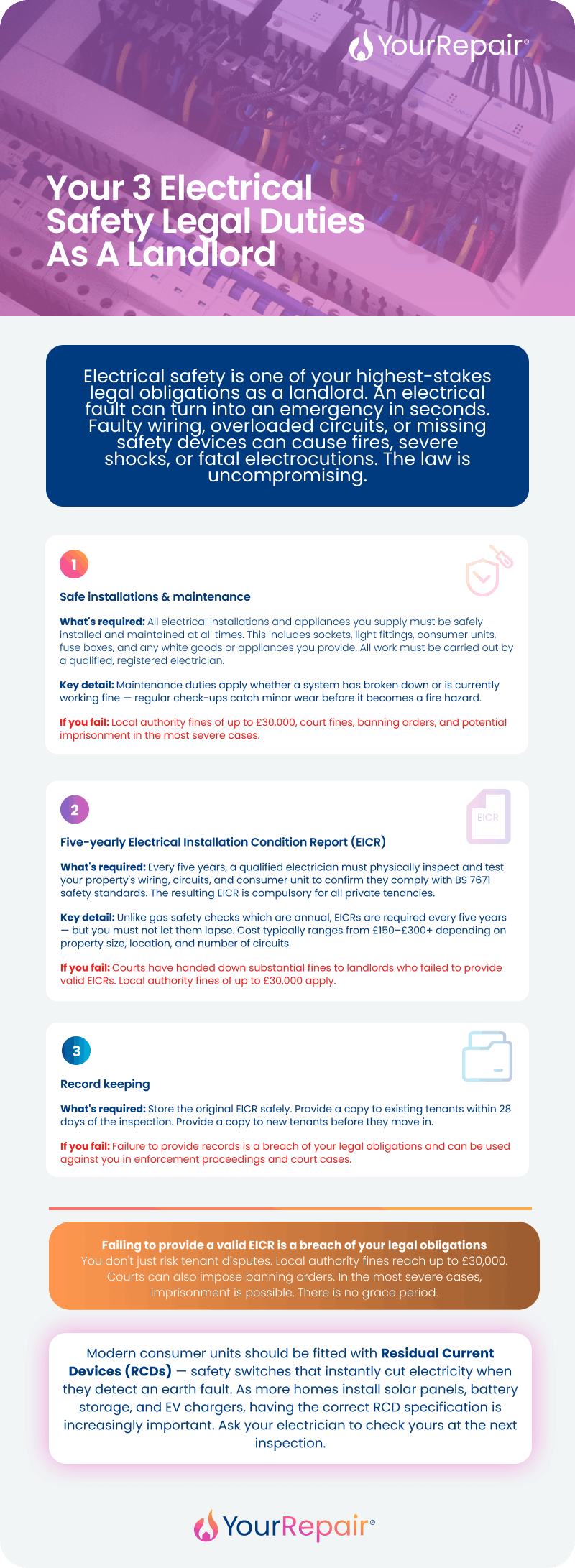
Every five years, private rented properties must undergo an electrical inspection by a qualified electrician to secure an Electrical Installation Condition Report (EICR).
Landlords are responsible for the safety of all:
- Fixed wiring
- Sockets
- Consumer units fitted with modern Residual Current Devices (RCDs).
And they must ensure regular Portable Appliance Testing (PAT) on any supplied white goods (fridges, freezers, washing machines, etc.).
An EICR typically costs £150 to £300+ depending on property size and location.
3. Damp, mould, and Awaab's Law
Landlords have a statutory duty to keep properties fit for human habitation throughout the tenancy.
Awaab's Law has been in force for social housing since October 2025. It sets timescales for investigating and fixing hazards.
The government has confirmed it intends to extend equivalent rules to private tenancies under the Renters' Rights Act, though no start date has been set yet.
4. Minimum Energy Efficiency Standards (MEES)
The government has confirmed that privately rented homes in England and Wales must reach a minimum EPC rating of C (assessed against new metrics) by 1 October 2030.
To protect landlords from excessive upgrade expenses, a cost cap of £10,000 to £15,000 per property is intended to apply.
Finding the right contractor to carry out energy efficiency or fire safety upgrades can be challenging given ongoing pressure on skilled trades. Checkatrade's Emma Grant has pointed to a shortfall of around 166,000 qualified tradespeople across the country. Landlords should plan works early and use trusted platforms to source competent tradespeople.
5. The private rented sector database
Under the Renters' Rights Act, landlords must register themselves and their properties on a new national database, rolling out regionally from late 2026 into 2027. Failing to register can block you from using standard possession grounds and carries heavy fines ranging from £7,000 up to £40,000 for serious or repeated breaches.
Keep your properties protected with Landlord Boiler Cover Get Covered
Compliance, cost management, and peace of mind
Staying on top of fire risk assessments, annual gas safety certificates, five-yearly EICRs, and shifting legal standards can feel overwhelming.
However, taking a proactive, structured approach to property compliance does more than just shield you from devastating civil and criminal penalties. It actively:
- Protects the lives of your tenants
- Builds long-term trust
- Preserves the value of your real estate portfolio.
Managing costs predictably
Staying fully compliant means budgeting for ongoing maintenance, tests, and repairs. A standalone gas check alone can cost £60 to £100.
A high-quality landlord home cover plan can turn sudden, expensive breakdowns into predictable, managed monthly costs.
Landlord boiler & home cover from YourRepair
We provide landlord boiler cover to property owners across England, Scotland, and Wales.
Our plans include 24/7 engineer access, unlimited claims, and your annual Gas Safety (CP12) check fully included.
By combining your annual gas safety checks with a proactive maintenance cover plan, you can manage seasonal expenses predictably and secure peace of mind.
Note: while our boiler cover plans simplify your heating compliance, they do not replace separate statutory requirements like EICRs or fire risk assessments, which must still be arranged independently.
For a free quote for your portfolio, get in touch with the YourRepair team today.