

Electrical Safety for Landlords: EICR, PAT Testing and Your Legal Duties
Landlords need to balance maintenance, tenant relationships and cash flow.
But above all, they have one non-negotiable duty: Tenants’ safety.
While landlords are responsible for several safety areas, electrical safety stands out as one of the highest-stakes.
Understanding your legal duties, how to handle access issues, and how electrical safety fits into your broader compliance checklist is essential.
Why electrical safety is a core legal obligation
As a landlord, you have responsibilities in several areas, including:
- Gas safety
- Fire safety
- General health hazards.
As with these, electrical safety stands out for two major reasons: immediate physical risk and severe legal consequences.
The life-or-death stakes
Unlike slow-developing issues (mould, pests, subsidence, etc.), an electrical fault can turn into an emergency in seconds.
Faulty wiring, overloaded circuits, or a lack of proper safety devices can lead to electrical fires, severe shocks, or fatal electrocutions.
So electrical safety calls for proactive checks, not passively waiting for tenants to report issues.
Keep your properties protected with Landlord Boiler Cover Get Covered
Criminal and civil liability
Landlords are legally required to ensure that the property's entire electrical installation and any electrical appliances they supply are safe.
If you rent out a property with dangerous wiring, you risk:
- Tenant disputes
- Local authority fines of up to £30,000
- Court fines
- Banning orders
There is even the potential for imprisonment in the most severe cases.
Courts have also handed down substantial fines to landlords who failed to provide valid Electrical Installation Condition Reports (EICRs) or otherwise failed to keep their properties safe.
Landlords' three primary electrical safety duties
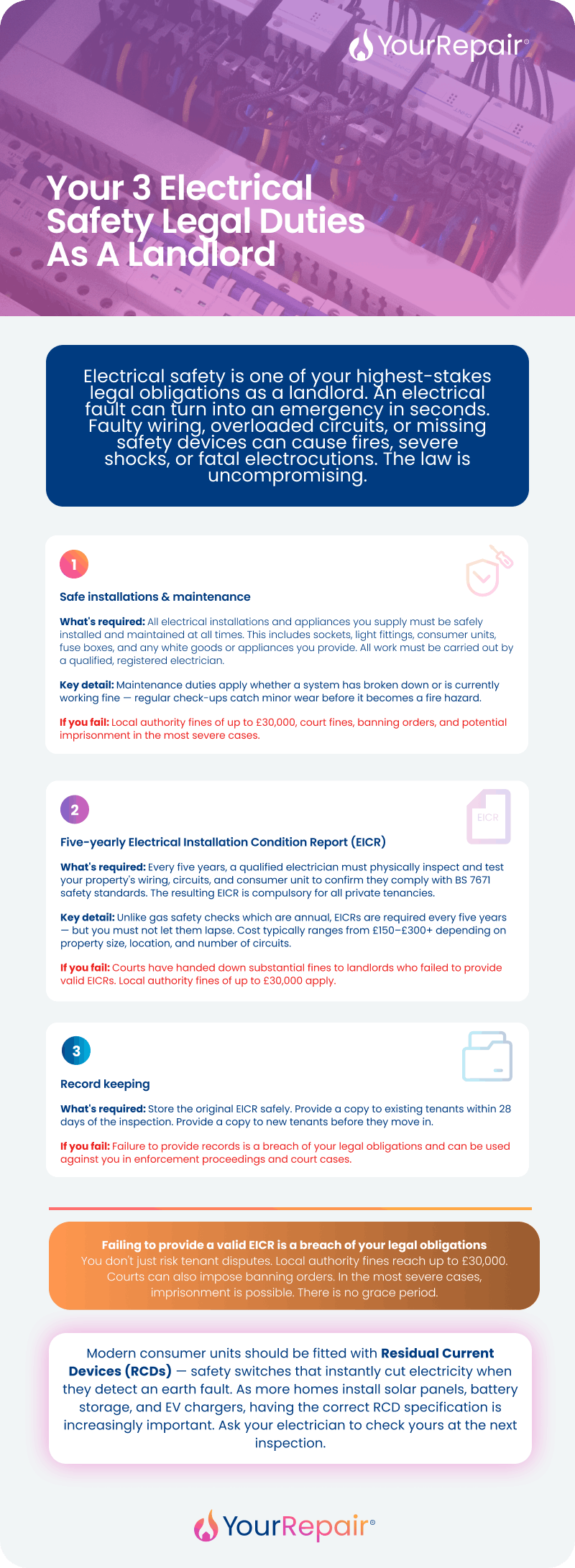
1. Safe installations & maintenance
You must ensure all of your properties’ electrical installations and equipment are safely installed and maintained. This includes:
- Sockets and light fittings
- Consumer units (fuse boxes) and safety switches
- Any electrical appliances (that you provided).
All electrical maintenance and repair work must be carried out by a qualified, registered electrician.
Maintenance duties still apply whether a system has actively broken down or is currently working fine.
Proper labelling on isolating switches and safe isolation practice before any work begins are basic, life-saving habits.
And regular electrical check-ups are the best way to catch minor wear before it turns into a fire hazard.
2. Five-yearly Electrical Installation Condition Reports (EICR)
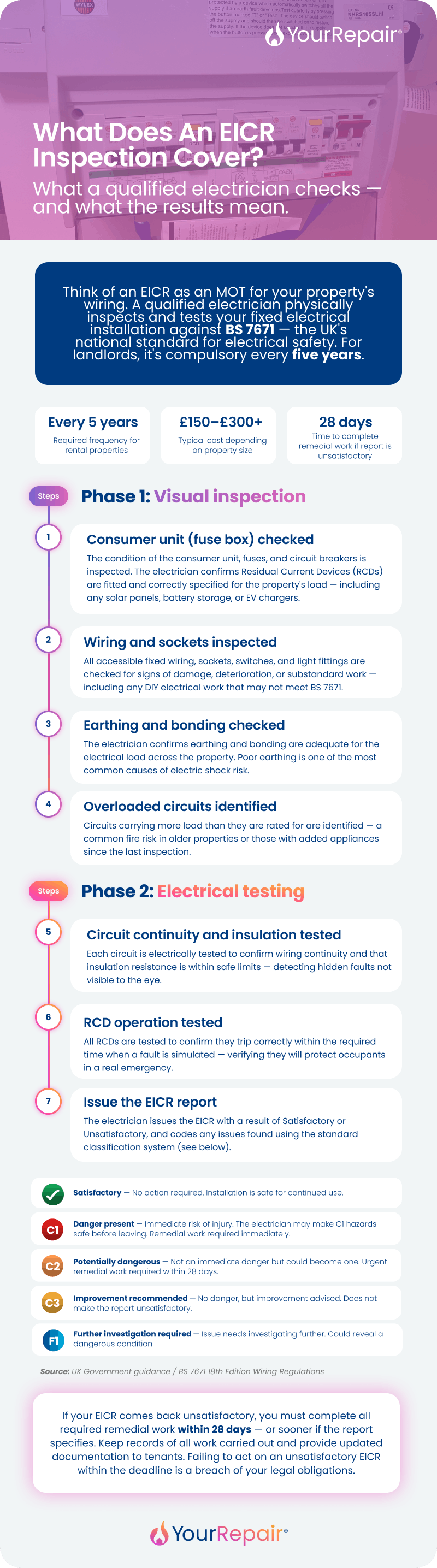
Every five years, you must have your property's electrical installations inspected and tested by a qualified person.
This inspection results in an Electrical Installation Condition Report (EICR), which is compulsory for private tenancies.
The inspection involves physically testing the wiring, circuits, and consumer units to confirm they comply with current BS 7671 safety standards.
3. Record keeping
Once your electrician completes the check, store the original EICR somewhere safe.
You must provide a copy of it to existing tenants within 28 days of the inspection. And for new tenants, you must provide a copy before they move in.
What needs checking and who pays for it
Landlord vs. tenant appliances
You're responsible for the electrical installations and appliances you make available to the tenant, including:
- Built-in wiring, sockets, light switches, and consumer units
- Landlord-supplied white goods (fridges, freezers, washing machines)
- Supplied cookers, kettles, and portable electric heaters
If a tenant brings their own appliance into the property, they're responsible for its safety. However, you remain responsible for the sockets and circuit feeding it.
Regular Portable Appliance Testing (PAT) on your supplied items is a good way to catch faulty cords or internal defects early.
Modern safety devices (RCDs)
Electricians and industry experts strongly advise ensuring your consumer unit is fitted with modern Residual Current Devices (RCDs).
RCDs are safety switches that instantly cut the electricity supply when they detect an earth fault. This helps to prevent fatal shocks.
More homes are installing solar panels, battery storage, and EV chargers, so having the correct type of RCD is becoming more important.
Always consult a qualified electrician to make sure your consumer unit is properly specified for what's plugged into it.
Keep your properties protected with Landlord Boiler Cover Get Covered
Factoring in the costs
An EICR typically costs in the region of £150–£300+, depending on your:
- Location
- Property size
- Number of circuits being tested.
This is an upfront cost but proactive maintenance and comprehensive landlord home cover plans can help spread it predictably.
How to handle tenant access problems legally
Gaining entry to carry out an EICR inspection is a common headache for landlords.
However, electrical safety is the landlord's statutory responsibility. So, you can't simply give up if a tenant ignores or refuses access. You must take all reasonable, documented steps to resolve it.
Give notice
You must give your tenant at least 24 hours' written notice of your intention to access the property for the safety check.
Try to arrange a mutually convenient slot with them directly.
Build a paper trail if they refuse
If the tenant ignores your requests or refuses entry, post a letter by recorded delivery explaining that the check is a legal requirement designed to keep them safe, and give them 14 days to respond.
Repeat this up to three times. This creates a documented record proving to local authorities and courts that you've taken all reasonable, practicable steps to comply with the law.
Escalate if needed
If they still refuse, contact your local council's housing team. A formal approach from a local authority officer often prompts cooperation.
As a last resort, you can apply to the courts for an injunction to gain access.
Important
Forcing entry is illegal for routine maintenance checks.
You're only permitted to enter by force in a genuine, active emergency, such as (for example):
- A major fire
- Active flooding
- A suspected gas leak.
Your other statutory landlord responsibilities
Electrical safety sits alongside several other major legal responsibilities you need to manage:
1. Gas safety (CP12)
Landlords must secure an annual Gas Safety Certificate from a Gas Safe registered engineer. It covers all landlord-supplied gas pipework, appliances, and flues.
2. Fire and e-bike safety
You must provide a working smoke alarm on every storey, and a carbon monoxide alarm in any room with a fixed combustion appliance (like a gas boiler or wood burner).
It's also worth sharing guidance with tenants on safe charging and storage of e-bike and e-scooter batteries. Lithium-ion battery fires are one of the fastest-growing fire risks in homes in recent years.
3. Damp and mould
Rented homes must be fit for human habitation throughout the tenancy. And landlords already have a legal duty to address serious damp and mould under existing housing law.
Note: Awaab's Law
Awaab's Law sets strict, legally binding timescales for investigating and fixing hazards. It currently applies to social housing only (in force since October 2025), but the government has confirmed it intends to extend equivalent rules to private tenancies under the Renters' Rights Act.
No start date has been set yet, but it's worth watching for updates rather than treating it as a current private-sector obligation.
Keep your properties protected with Landlord Boiler Cover Get Covered
4. Minimum Energy Efficiency Standards (MEES)
The government has now confirmed that privately rented homes will need to reach an EPC rating of C (assessed against new metrics) by 1 October 2030, unless a valid exemption applies. A cost cap of £10,000–£15,000 per property is intended to protect landlords from excessive upgrade costs. In the meantime, upgrading heating and insulation ahead of the deadline keeps you compliant early and can lower tenants' bills.
5. Private Rented Sector Database
Under the Renters' Rights Act, landlords will need to register themselves and their properties on a new national database. It's rolling out regionally from late 2026, with fuller national rollout continuing into 2027. Once it applies to you, failing to register can block you from using standard possession grounds and carries fines from £7,000 up to £40,000 for serious or repeated breaches.
Compliance and peace of mind
Taking a proactive, structured approach to your properties shields you from fines and penalties. But, more importantly, it protects the lives of your tenants. And it also builds trust, and preserves the long-term value of your portfolio.
Managing costs alongside compliance
Staying compliant means budgeting for ongoing costs too. You need to pay for EICRs, PAT testing, gas safety checks, and any repairs that come up along the way.
A good cover plan can help turn sudden bills into predictable costs.
Landlord boiler cover from YourRepair
We provide landlord boiler cover to landlords across England, Scotland, and Wales, including 24/7 engineer access, unlimited claims, and an annual Gas Safety check.
It's worth noting this covers your boiler and heating system specifically — it doesn't replace your other statutory duties, like EICRs or electrical maintenance, which still need to be arranged separately.
For a free quote, get in touch today.
Read more: What Is Landlord Boiler Cover?