

Boiler Not Working? Common Problems, Fixes & Costs
A broken-down boiler is disruptive for any home, especially during winter.
Before you book an emergency call-out, there are several simple checks you can carry out yourself.
Some boiler issues are surprisingly easy to fix yourself.
Boiler repairs can be highly hazardous. While this guide helps you identify common faults, you should always consult a Gas Safe registered engineer to perform any internal repairs. It will ensure your safety and keep your manufacturer's warranty valid. Never ignore a boiler that is behaving unusually. It can leak carbon monoxide, an extremely dangerous, odourless, and tasteless gas.
Read: Carbon Monoxide: What It Is, Why It's Dangerous and How to Detect It
6 steps for checking your boiler yourself
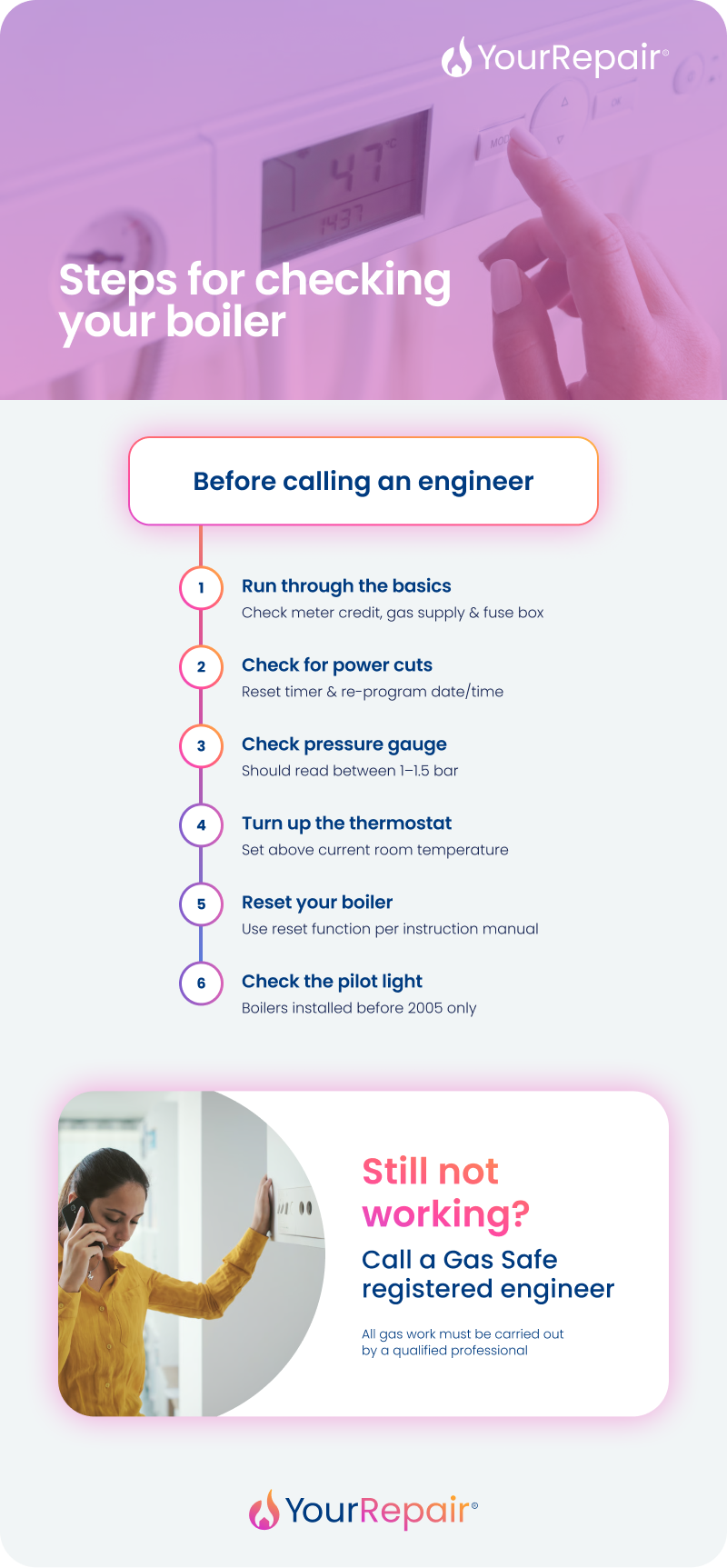
If your heating or hot water has stopped working, run through this step-by-step diagnostic checklist before calling for help.
1. Run through the absolute basics
You should always rule out external utility issues first:
- Prepayment meters: If you use a prepayment gas or electricity meter, check that you haven't run out of credit or pushed it into negative emergency credit
- Gas supply: Turn on another gas appliance in your home (like a gas hob) to verify if gas is actively flowing to your property
- Fuse box: Check your consumer unit to see if a fuse has tripped.
No power to your boiler?
Check these first If your boiler display is blank and the unit won't respond, run through these checks:
The fused spur switch
Your boiler is wired to a dedicated fused connection unit (FCU) on the wall
It’s usually within a few feet of the boiler itself. Make sure this switch is in the ON position. It can be accidentally knocked off, particularly when a boiler is in an airing cupboard.
Your consumer unit (fuse box)
Boilers have their own circuit breaker.
Open your fuse box and look for a tripped breaker labelled "boiler" or "heating." Reset it by turning it fully off and then back on.
The boiler's inline fuse
Older boilers often contain a small ceramic fuse (typically 3A) inside the control panel. If this fuse has blown, the boiler will have no power.
A Gas Safe engineer can check and replace this.
After a power cut
A power cut can reset your boiler's electronics, leaving the display blank even after power is restored.
Press and hold the reset button until the display reignites. If it stays blank, the power surge may have damaged the PCB, which will need professional to check.
If your boiler has power (the display lights up) but is still not working, continue with the checks below.
2. Check for recent power cuts
A temporary power cut or a tripped fuse can desynchronise your boiler’s timer settings. If this has reset, your boiler won't know when it's supposed to turn on.
What to do
Inspect the display clock on your boiler controls. If it is displaying the wrong time, reset your timer controls with the correct date and time.
Did you know? Before boilers became commonplace in the late 1970s, fireplaces were the norm in UK homes. Fireplaces first appeared in Britain in Norman castles in the 12th century. They were immediately copied in wealthy homes and by the end of the century new innovations (like a projecting hood) were added. Chimneys didn’t appear until the 15th century. And it wasn’t until the 18th century that fireplaces became the norm in all homes. Before that, most people had hearths (a flat stone or brick surface in the centre of a room where fires could be lit).
3. Inspect the boiler pressure gauge
Your system needs the correct pressure to run efficiently. If there’s too little, the boiler will lock out for safety.
And if there’s too much, it can damage your pipes and seals, and potentially cause leaks.
What to do
Locate your pressure gauge. Modern boilers display this digitally, while older systems have a hydraulic dial with a needle, often found underneath the unit.
What's normal
A healthy cold boiler should read between 1 and 1.5 bar.
If the needle has fallen below 1 bar, you will need to repressurise the system yourself using your filling loop or filling key. And if it’s below 0.5, the issue is much more urgent.
Boiler breakdowns hit hardest when your heating bill is highest. January is the coldest month in the UK on average (around 4°C), and a typical 3-bedroom household spends roughly £150 on gas that month alone. Next comes February (£135) and December (£120). By contrast, July (£15 - £20) is the warmest month (around 19°C), when gas is used mostly to heat water.
4. Check your thermostat
Boilers only fire when your thermostat sends a signal for heat. If the latter isn't working correctly, your boiler might stay idle even though everything else is working.
The click test
Turn your thermostat up above the current room temperature and listen carefully. A working thermostat makes an audible click when it sends the signal.
If you hear a click but the boiler still doesn't fire, the fault is more likely in the boiler itself.
If there's no click at all, the problem is likely in the thermostat or its connection to the boiler. Work through the checks below.
Dead batteries
Wireless thermostats run on AA or AAA batteries. Flat batteries are one of the most common causes of a boiler stopping working overnight. You can swap these out yourself.
Lost wireless pairing
Smart and wireless thermostats communicate with a small receiver unit wired near your boiler. Check that the receiver has a lit LED. If not, the thermostat and receiver have lost their connection. Try re-pairing them by following your manufacturer's guide.
Read: Smart Thermostats UK: Control Your Heating & Cut Bills
Thermostat in the wrong location
If your thermostat sits in a sunny hallway or near a radiator, it may read the room as warmer than it actually is. This stops it sending a call for heat, because it senses a heat much higher than the room's overall average. Move it temporarily to a cooler room to test.
Wired programmers
If you have an older wired programmer, check that the correct heating schedule is active and that the clock is showing the right time. A power cut will reset both.
If you've worked through all of the above and the boiler still won't respond, the fault is likely with the receiver unit, the wiring, or the PCB. A Gas Safe engineer will be needed.
5. Reset your boiler (and respect the sequence of operations)
Modern boilers follow a strict, step-by-step electronic sequence of operations to start up safely.
If a built-in safety sensor detects a missing step (like no ignition or restricted airflow), the boiler will lock out.
What to do
Locate the reset button on your boiler's control panel and hold it down.
Safety first!
If your boiler locks out repeatedly, never attempt to bypass or "jump out" safety controls to force it to run.
In the boiler trade, engineers warn: "Don't be the hero". A repeated lockout is telling you that a real mechanical issue exists and needs professional diagnostics.
Read: How to Cut Your Heating Bills — 10 Tips That Actually Work
Understanding your boiler's error code
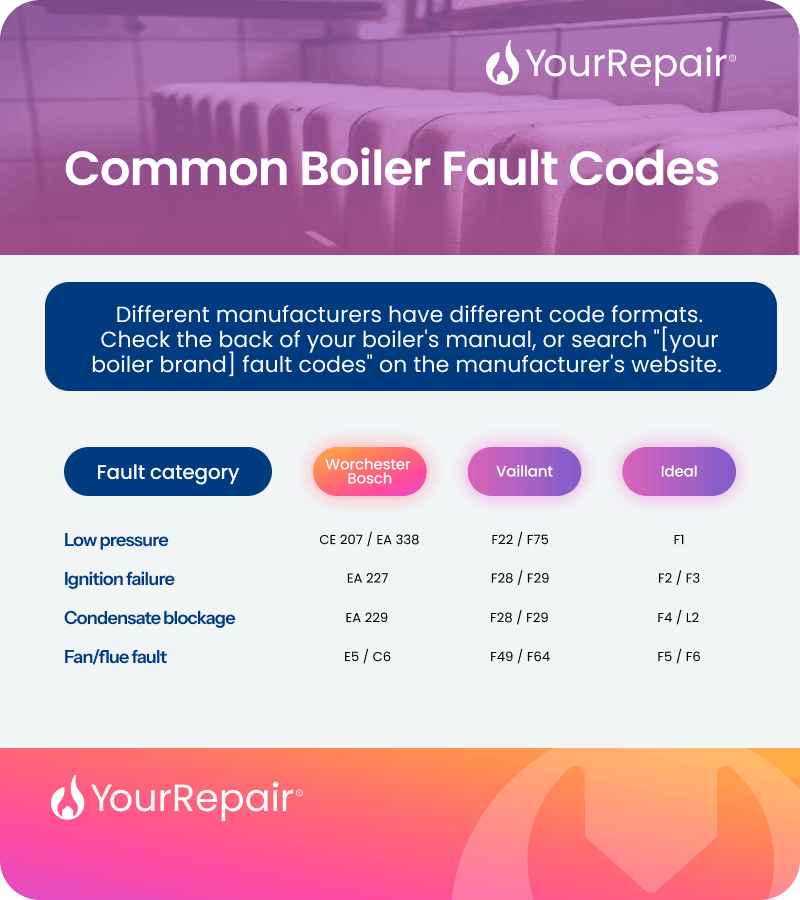
When modern boilers lock out, a fault code appears on their control panel. It should be a letter and number combination that tells you which startup sequence step failed.
Different manufacturers have different code formats. Check the back of your boiler's manual, or search "[your boiler brand] fault codes" on the manufacturer's website.
Below are the most common fault codes for the main UK boiler brands.
Low water pressure
This means your boiler can't circulate water safely.
- Worcester Bosch: D5 or EA 218
- Vaillant: F22 or F75
- Ideal: F1 or L1 (on some models)
- Baxi/Potterton: E119 or E1
What to do: Follow the re-pressurising guide above to bring the system back to 1–1.5 bar, then press reset.
Ignition failure
This means your boiler attempted to light but couldn't detect a flame.
- Worcester Bosch: EA 338 or E9
- Vaillant: F28 or F29
- Ideal: F2 or F3
- Baxi/Potterton: E28 or E131
What to do: First, check your gas is on (try turning on a gas hob). If it is, reset the boiler. If it locks out again immediately, you will need to contact a Gas Safe engineer.
Condensate blockage
When the external pipe carrying wastewater from your boiler is frozen or blocked.
- Worcester Bosch: EA 229
- Vaillant: F34
- Ideal: F4 or L2
What to do: See the frozen condensate pipe guide below. Once it’s thawed and pipe is flowing, reset your boiler.
Fan or flue fault
When the fan that expels combustion gases isn't running correctly (so the boiler won't ignite for safety reasons).
- Worcester Bosch: E5 or EA 217
- Vaillant: F49 or F64
- Ideal: F5 or F6
- Baxi/Potterton: E3 or E117
What to do: This one requires a Gas Safe engineer, so do not attempt to reset repeatedly.
6. Check the pilot light or burner scanner
For older boilers (pre-2005) Check if the permanent pilot flame has gone out. If it has, check your instruction manual to see if you can safely relight it yourself.
For modern condensing boilers If your boiler is starting up but immediately shutting down intermittently, the issue could be a dusty burner scanner (flame sensor).
If this tiny optical sensor gets covered in soot or dust, it can't "see" the burner flame. This causes the circuit board to shut the gas valve down as a safety precaution. An engineer can quickly clean this during a routine boiler service.
6 common boiler problems (& what they cost to fix)
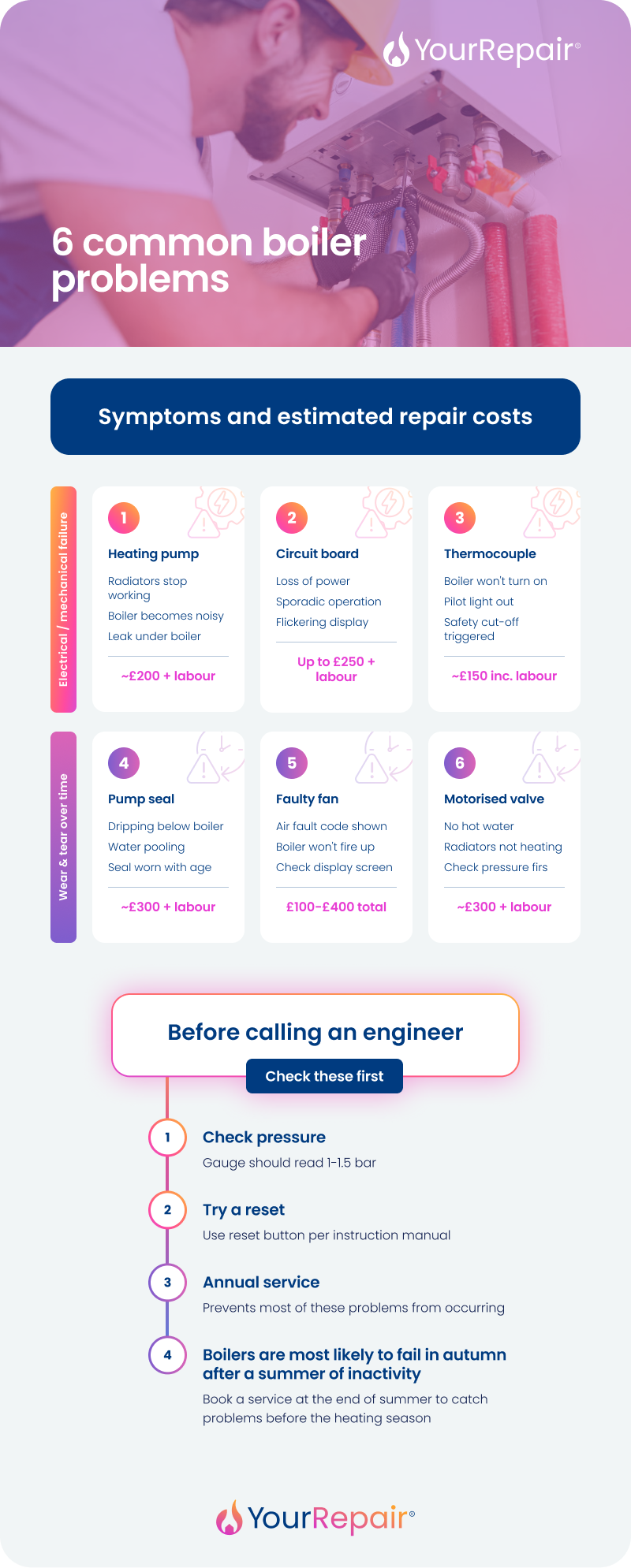
If you have completed the basic checks and your boiler is still refusing to work, an internal component has likely failed. The below lists common failures and how much they are likely to cost.
In the heating industry, small details create big problems. Neglecting minor faults can lead to serious damage down the line.
Here are the six most common component failures, why they happen, and what you can expect to pay a Gas Safe engineer to fix them.
1. Central heating pump failure
The pump acts as the heart of your heating system, pushing hot water out of the boiler and around your radiators.
- Why it fails: Pumps often become inactive during autumn after being unused during the summer. This can lead to stagnant water and sludge cause the internal propeller or bearings to seize up
- Signs: Noisy operation, radiators failing to heat up, or a leak dripping directly from the pump casing
- Cost to fix: Expect to pay around £200 for a high-quality replacement pump, plus the engineer's labour to fit it.
2. Faulty printed circuit board (PCB)
The PCB is your boiler's "brain." It coordinates every part of the startup sequence.
- Why it fails: Typically caused by age, electrical surges, or water leaking internally onto the board from a cracked component
- Signs: Complete loss of power, a flickering display screen, or highly sporadic operation where the boiler works one minute and shuts off the next. Check if the boiler’s fuse has simply blown before replacing the entire board
- Cost to fix: A replacement PCB is a specialist part and usually costs up to £250, plus labour.
3. Broken thermocouple
The thermocouple is a simple safety device positioned next to the pilot flame (found in older boilers with a standing pilot light).
- Why it fails: Exposure to extreme temperature fluctuations over many years causes metal fatigue. The constant expansion and contraction eventually crack the sensor, preventing it from verifying if the flame is lit. For safety, the boiler will refuse to ignite to prevent unburned gas from escaping.
- Signs: The pilot light won't stay lit.
- Cost to fix: While the sensor part is incredibly cheap, the standard cost for a Gas Safe engineer to supply and fit a new thermocouple is approximately £150.
4. Leaking pump seal or pressure relief valve
- Why it fails: Rubber seals and gaskets naturally dry out, perish, and wear down over time.
- Signs: Continuous dripping or pooling water underneath your boiler casing.
- Cost to fix: If your pump is older, an engineer will usually advise replacing the entire pump rather than just the seal, as an old pump is likely to fail soon anyway. Expect to pay approximately £300 for the replacement pump and labour.
5. Faulty extractor fan
The fan is a critical safety component. It extracts dangerous flue gases out of your home through the exhaust pipe.
- Why it fails: The bearings and electrical motor windings build up wear and tear over time. If the fan fails to run, the PCB will halt the startup sequence and refuse to ignite the burner
- Signs: An "air fault" code flashing on your display panel
- Cost to fix: Depending on your boiler type and model, replacement fans cost between £100 and £200. Add to this approximately the same in labour, and the total to around £200 to £400.
6. Motorised valve failure
Motorised zone valves open and close to direct hot water to either your radiators or your hot water cylinder.
- Why they fail: Like pumps, motorized valves are highly susceptible to seizing up during summer inactivity
- Signs: You have hot water but completely cold radiators (or vice-versa)
- Cost to fix: Replacing a motorised valve is a major, time-consuming job, as your entire heating system must be drained down before the old part can be removed. You can expect to pay approximately £300 for the part and professional installation.
Boiler keeps cutting out
Boilers with issues often repeat a pattern called short cycling (or repeated lockout). This is when the boiler fires up, runs for a few minutes, then shuts off. It nearly always points to one of the following:
Low or dropping pressure
If your boiler pressure falls below 0.5 bar, it will lock out for safety. If you repressurise it and the pressure drops again within days, there is a leak somewhere in your system. It’s often in a pipe joint, radiator valve, or the pressure relief valve itself.
This leak needs to be found and sealed.
Overheating
If limescale has built up on the heat exchanger, the system can't transfer heat into the water efficiently. This leads to overheating, and the boiler shutting down after thermal cutout trips.
A power flush can usually remove the scale (see below). But in severe cases, the heat exchanger will need replacing.
A failing flame sensor
As described in the pilot light section above, a dirty or degrading flame sensor (ionisation probe) means the boiler can’t confirm the flame is present and so shuts down. An engineer can clean or replace this.
Boiler won't turn off
A boiler that won't turn off will overheat your home and increase your gas bill significantly. It's worth having an engineer investigate rather than just turning the boiler off at the fused spur each evening.
This issue is often caused by one of the following:
A jammed motorised zone valve
This is the valve that controls flow to your radiators. If it fails in the open position, hot water will keep circulating. You may notice the pump running constantly and radiators that never fully cool.
A faulty thermostat
A faulty thermostat might not send the off signal correctly.
Gravity circulation on an older system
Back boilers or older gravity-fed systems might continue to circulate hot water even when the pump is off. This is because heat rises naturally through the pipes. Engineers can fit check valves to prevent this.
System pipe and radiator issues
Sometimes, your boiler is functioning perfectly, but issues elsewhere in your central heating system prevent heat from circulating.
Airlocks and cold radiators
If your radiators are hot at the bottom but cold at the top, air is trapped in your pipes. You can easily resolve this yourself in minutes by bleeding your radiators.
Limescale and sludge
Over time, rust and minerals build up inside your heating system. Limescale and sludge are the "silent killers" of heating efficiency. They block water flow and coat the heat exchanger, forcing your boiler to use more gas. This directly increases your energy bills.
If your water pressure drops repeatedly, or radiators are cold at the bottom, your system may require a power flush to clear the debris. This is something you cannot do yourself - you will need to call a professional.
Frozen condensate pipes
During freezing weather conditions, the white plastic condensate pipe running outside your house can freeze solid.
This ice blockage causes acidic water to back up, triggering an automatic safety shutdown.
You can resolve this yourself by gently pouring warm (not boiling) water over the outdoor pipe to thaw it. Afterwards, you just need to reset your boiler.
Repairing vs. replacing boilers
The 50% rule
A rule of thumb in the heating industry is that if the repair cost exceeds 50% of a new boiler's price, replacement is usually the better investment.
For example, a new Worcester Bosch or Vaillant combi typically costs £1,500–£3,000, including installation. So any repair above £750–£1,500 on an older unit is worth carefully considering.
Boiler age
Modern condensing boilers have an expected lifespan of 10–15 years (with annual servicing).
Boilers over 12 years old and on their second or third significant repair may not be worth keeping.
Efficiency
Boilers manufactured before 2005 typically operate at 70–78% efficiency. This means up to 30p in every £1 of gas is wasted. By contrast, modern A-rated condensing boilers run at 90%+ efficiency.
So, in an average home, upgrading from an old G-rated boiler can save £300–£500 per year in gas bills. This can offset the cost of a new boiler within a few years.
Frequency of breakdowns
One repair every few years is normal. But if you're calling an engineer two or more times in a single heating season, the boiler might be wearing down.
If you're uncertain, a good Gas Safe engineer will give you an honest assessment.
Expert boiler cover with YourRepair
Unexpected boiler breakdowns can happen. Get protected today with boiler cover from YourRepair. T&Cs apply.