

What Should My Boiler Pressure Be? How to Fix Low and High Pressure Yourself
Your boiler heats cold water and sends it around your home's circuit of pipes and radiators.
For your central heating system to work as efficiently as possible, it is vital to maintain stable water pressure within the system.
Boiler pressure refers to the strength of water running within this sealed system
Over time, operating your boiler at the wrong pressure—whether too high or too low—can:
- Cause your heating system to stop working
- Increase your energy bills
- Cause costly damage to your home.
This guide combines expert advice to help you "know normal" for your boiler, troubleshoot pressure issues, and safely make adjustments yourself.
Getting to "know normal"
To keep your system running safely and out of emergency mode, you must get to "know normal" for your specific boiler through frequent visual checks.
What is the normal pressure range?
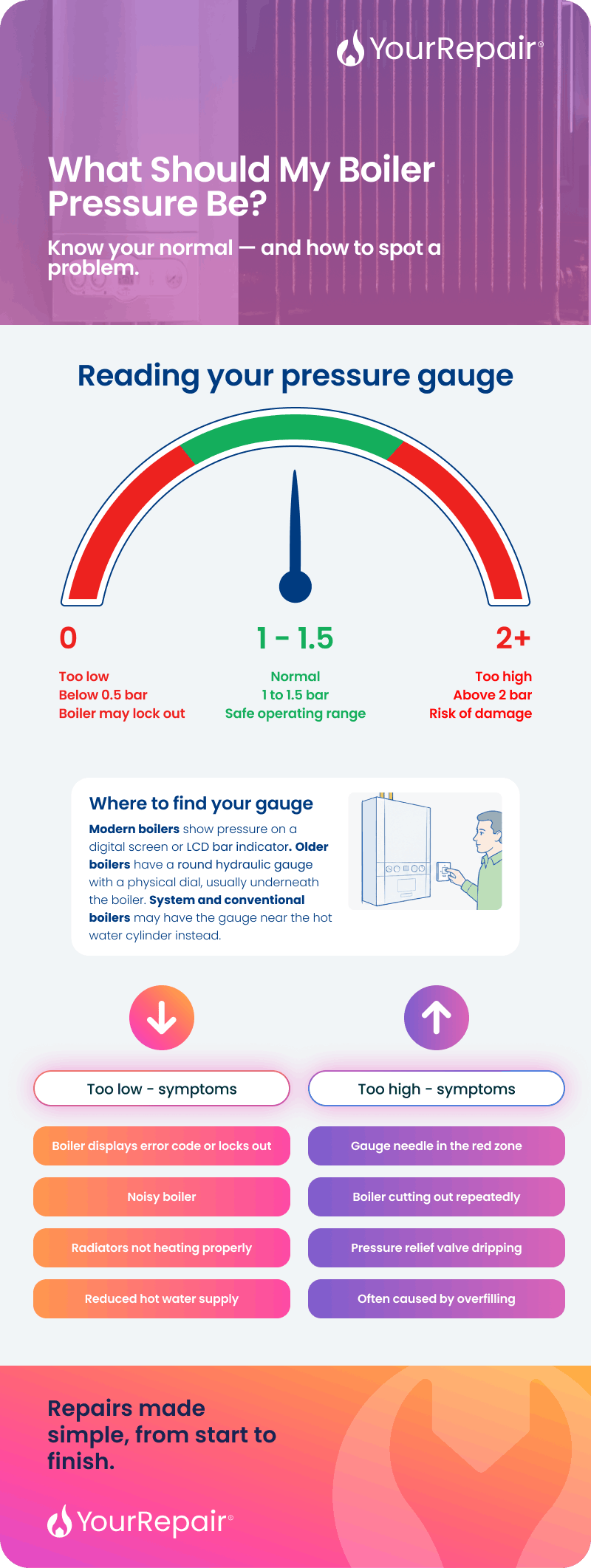
For most conventional and combi boilers, normal operating pressure should be between 1.2 and 1.5 bar.
British Gas notes that when your heating is completely turned off and the system is cold, the pressure should be between 1 and 1.5 bar.
Where do I check the pressure?
- Modern boilers typically display a digital pressure reading or a bar indicator on an LCD screen.
- Older boilers feature a round hydraulic gauge with a physical dial and needle, usually found underneath the boiler.
- Conventional and system boilers (which rely on a separate water tank and hot water cylinder) may not have the gauge on the boiler itself. Instead, you will often find the pressure gauge and filling valve located near your hot water cylinder, usually beside a smaller red vessel.
Boiler pressure too low: Causes and how to fix it
Your boiler's pressure is too low if your digital reading or physical needle drops below 0.5 bar.
When this happens, modern boilers will typically display a flashing error code or lock out completely to protect the system.
Why do boilers lose pressure?
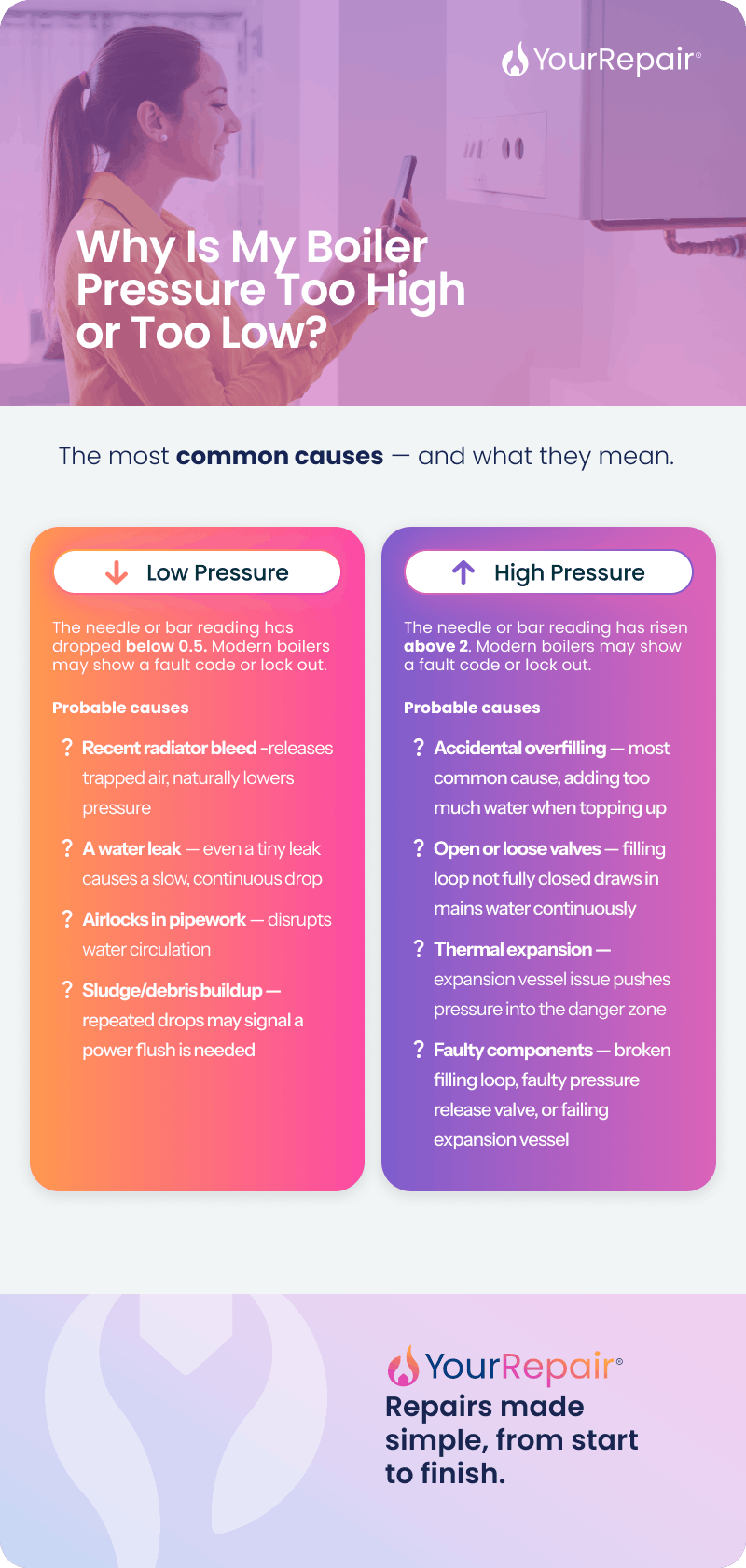
Losing pressure is the most common boiler issue you are likely to encounter, sometimes happening a couple of times a year. Typical causes include:
- Bleeding your radiators: Releasing trapped air from your radiators naturally lowers the overall system pressure.
- A water leak: Even a tiny leak in the pipes, valves, or radiators around your home can cause a slow, continuous drop in pressure.
- Airlocks in your pipework or issues with your expansion vessel.
- Sludge and system debris: Repeated pressure drops can sometimes indicate debris buildup, which may require an engineer to perform a power flush.
Is low boiler pressure dangerous?
Low boiler pressure is not physically dangerous. However, ignoring it can harm your heating system over time.
It reduces your heating efficiency, can make your boiler noisy, limits your hot water supply, and will ultimately increase your energy bills.
How to increase boiler pressure (repressurising)
Before attempting to top up your boiler, always switch off your boiler and let it cool down completely for 4 to 6 hours.
This is a vital safety step to prevent dealing with scalding hot water.
Method 1: Using a worcester bosch "filling key"
Newer Worcester Bosch models use an internal key system.
- Locate the key: Pull out the tray underneath your boiler and unclip the plastic filling key.
- Insert the key: Push the key firmly into the keyhole of the manifold (the valve assembly underneath the boiler).
- Unlock: Turn the key approximately 45 degrees to the unlocked position.
- Fill: Watch the pressure gauge closely. Once it reaches 1.5 bar, turn the manifold nut clockwise to stop the water flow.
- Lock and return: Turn the key back to the locked position, remove it, and return it to the tray.
- Switch on: Power your boiler back on; the pressure should settle within a minute or two.
Warning: If the pressure gauge enters the red zone, stop filling immediately and switch the boiler off. If pressure remains high, do not use the boiler, as a malfunctioning system can pose a carbon monoxide risk, and contact a Gas Safe registered engineer.
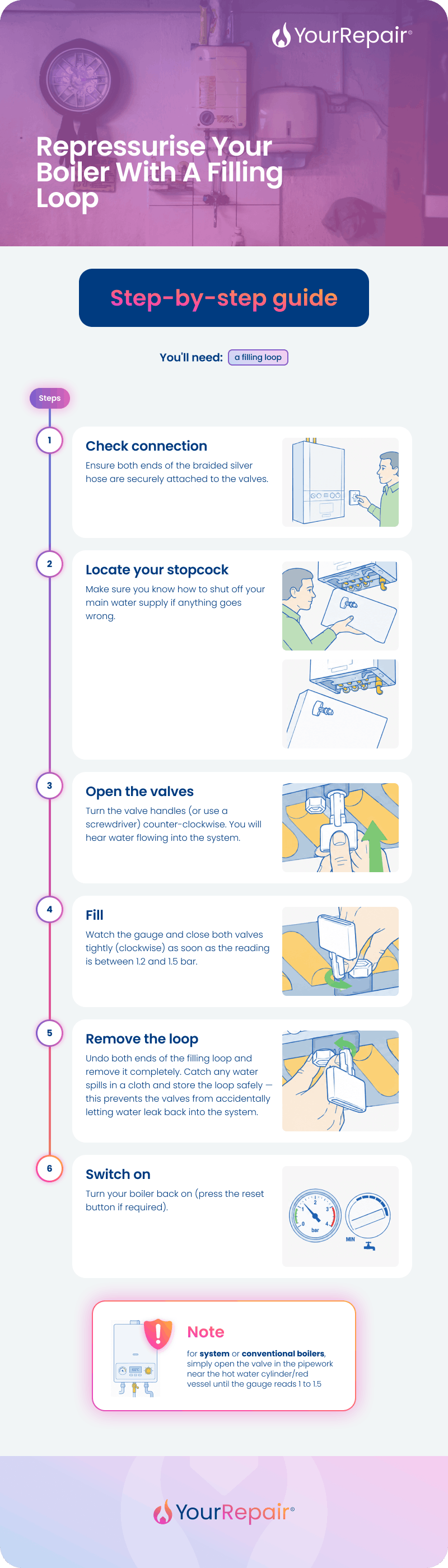
Method 2: Using a braided silver "Filling Loop"
This is the most common method for other boiler brands.
- Check connection: Ensure both ends of the braided silver hose are securely attached to the valves.
- Locate your stopcock: Make sure you know how to shut off your main water supply if anything goes wrong.
- Open the valves: Turn the valve handles (or use a screwdriver) counter-clockwise. You will hear water flowing into the system.
- Fill: Watch the gauge and close both valves tightly (clockwise) as soon as the reading is between 1.2 and 1.5 bar.
- Remove the loop: British Gas recommends that you undo both ends of the filling loop and remove it completely. Catch any water spills in a cloth and store the loop safely. This prevents the valves from accidentally letting water leak back into the system.
- Switch on: Turn your boiler back on (press the reset button if required).
Which way do you turn the filling loop valve?
To open (let water in): Turn counter-clockwise.
To close (stop water flow): turn clockwise.
If your valves have flat-head screw slots instead of handles, use a screwdriver in the same direction.
For system or conventional boilers, simply open the valve in the pipework near the hot water cylinder/red vessel until the gauge reads 1 to 1.5 bar, then close it.
Boiler pressure too high: Causes and how to fix it
Your boiler's pressure is too high if the needle or digital reading moves above 2 bar (or into the red zone).
What causes high boiler pressure?
- Accidental overfilling: The most common culprit is adding too much water when trying to resolve low pressure.
- Open or loose valves: If the filling loop or pressure valves under your boiler are not closed tightly, they will continuously draw mains water into the system.
- Thermal expansion: Water expands naturally as it heats up. If parts of your boiler (like the expansion vessel) are expanding or have incorrect air levels, this can push pressure into the danger zone.
- Faulty components: A broken filling loop, a faulty pressure release valve, or a failing expansion vessel can cause pressure to climb.
What is the boiler pressure relief valve (PRV)?
The pressure relief valve is a small but critical safety device built into your boiler. Its job is to release water automatically if the system pressure climbs dangerously high. This protects your boiler, pipes, and home from damage.
You can identify it by the small copper or plastic pipe it connects to. This runs out through an external wall and drips outside your house.
If this pipe is dripping continuously, it means your PRV is actively releasing pressure.
It's a sign that your system pressure is consistently running too high and needs investigating. Whilst this scenerio shows the valve itself is doing its job correctly, the underlying cause (overfilling, a faulty expansion vessel, or a stuck filling loop) needs a Gas Safe registered engineer to diagnose and fix
How to safely reduce boiler pressure yourself
If your gauge is reading above 2 bar, you can attempt to lower it safely using these steps:
- Turn off and cool: Switch off your boiler and wait for the system to completely cool down.
- Check the valves: Double-check that your filling loop and all pressure valves under the boiler are closed completely tight (clockwise) so no more water can enter.
- Bleed your radiators: This is the easiest and safest way to lower boiler pressure without touching the boiler itself. After turning your radiators off, use a radiator key to slowly release trapped air and excess water into a cloth or container. Watch the pressure drop on your boiler gauge as you do this.
- Recheck the gauge: Ensure the pressure has returned to a normal range of 1.1 to 1.5 bar.
Essential safety warning!
Do not attempt to adjust the pressure relief valve on the boiler or drain water directly from the boiler itself. British Gas strongly advises against this because water inside the boiler can gush out at scalding temperatures (70°C to 80°C). Bleeding your radiators does not always lower the pressure. In this case, keep the boiler switched off, place a container underneath the pressure relief valve to catch any minor leaks, and contact a Gas Safe registered engineer immediately.
Expert boiler cover with YourRepair
Unexpected boiler breakdowns can happen. Get protected today with boiler cover from YourRepair. T&Cs apply.