

Why Your Toilet Is Not Flushing (and How to Fix It)
A toilet not flushing when you’re at home is annoying.
A toilet not flushing when you’re a guest in someone else’s home is a nightmare!
Read on to learn common reasons why toilets don’t flush and how to fix them.
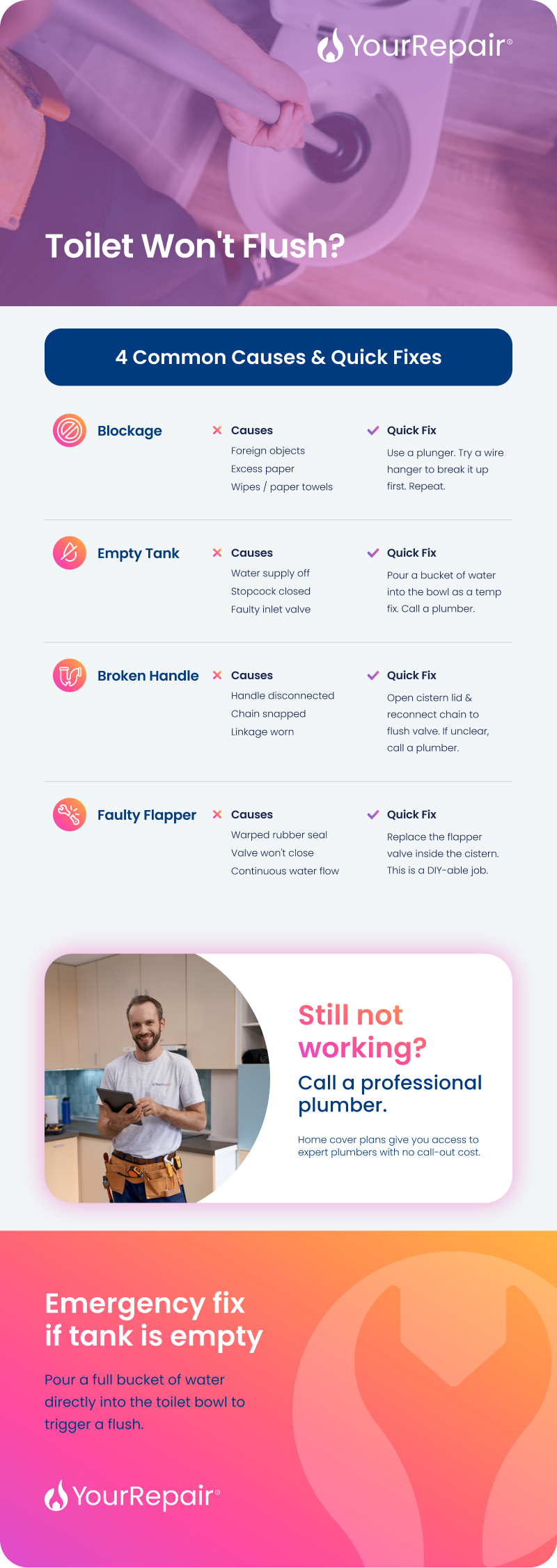
1. Blockages
There’s a plumbers’ saying: Only three Ps should go down the toilet and one of them is paper.
However, in toilets - as in life - things don’t always go according to plan. (Perhaps another plumbers’ saying?)
Toilet blockages are a common plumbing problem. They might be caused by:
- Objects being dropped in toilet bowls
- Heavy toilet paper usage
- Use of materials in place of toilet paper (paper towels, toilet wipes, newspapers, etc.)
There are other potential causes, too. But let’s move onto the solutions.
Fixing blockages
Did you know? In ancient Rome, public latrines could sit up to 20 people side-by-side on long stone benches with no dividers. Instead of toilet paper, they used a shared sponge attached to a short wooden stick, washed in water or vinegar between uses.
A toilet blockage is usually best dealt with using a plunger.
It can be unpleasant, but it can also be a quick and simple way to avoid calling a plumber.
If your first attempt doesn’t work, try inserting a wire hanger down into the toilet.
This could break up the obstruction enough for a second (or third) plunger attempt to work.
Read: How to Unblock a Toilet Without a Plunger
Toilet won't flush but isn't blocked?
You are likely dealing with a mechanical problem in your cistern.
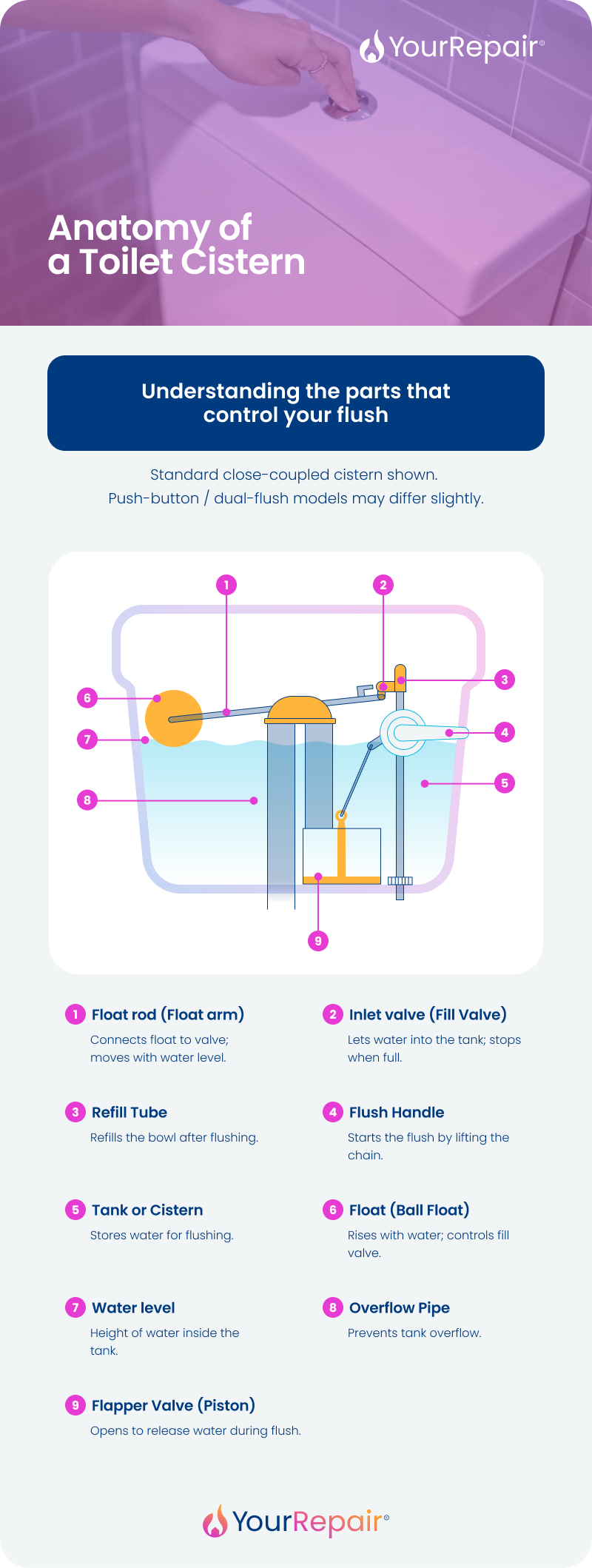
Toilets rely on gravity: When you push the handle or button, a chain lifts a valve at the bottom of the tank to release the water. If that connection breaks, the flush will not work.
One of the following three points will likely be the cause.
2. No water in the cistern or tank
If there isn’t enough water in the toilet’s tank, you won’t be able to flush it.
After all, the tank relies on water to work.
Check by opening the top of your cistern. This might be located behind a wall panel but there should be an access panel available.
If the tank is completely dry, you should check three things (in this order):
- Your mains supply: Turn on a nearby basin tap to make sure your household water is still running.
- Stopcock: Check the isolation valve on the pipe leading to your toilet. It might have been turned off by accident.
- The inlet valve: Locate the plastic float inside the cistern. Push the float arm down. If water does not flow in, or only trickles out weakly, your inlet valve or float mechanism could be blocked with scale.
Did you know? Queen Elizabeth I’s godson Sir John Harington invented the very first modern flushing toilet in 1596. He first built one at his home in Kelston, Somerset, then later installed one for the Queen at Richmond Palace. It used a lever-and-valve design but had no water trap, so still stank. 180 years later, Scottish inventor Alexander Cumming solve this by patenting the "S-trap" which used standing water to seal out bad smells.
(Temporarily) fixing a lack of water in the tank
You can flush the toilet in the meantime by pouring a bucket of water into the bowl.
Afterwards, you need to call in a plumber to check that your toilet plumbing is working correctly.
3. Broken handles or push buttons
Lever handles and flush buttons can easily become disconnected from the main flushing mechanism. When this happens, pushing the handle or button might feel either loose or stiff.
Traditional lever handle are usually connected to a metal lift arm and a thin chain. If the chain has snapped or fallen off, the handle can’t lift the flapper to trigger the flush.
Dual-flush push button are different. They use plastic plungers (or cables) connected directly to the drop valve.
If a button gets stuck down, water will run continuously into the bowl. And if the internal plastic clips snap, the button will fail to lift the valve. Check inside the system to see if the chain or cable is still firmly plugged into both the button and the valve.
4. Broken or warped flapper
A flapper is the valve which sits at the bottom of the cistern and allows the water to flow out. Issues with them are common in both older and modern toilets.
If the water from the toilet is continually flowing and it is never able to fill up, then you won’t be able to get a full flush.
If this happens, you will need to replace the flapper inside your cistern.
Read: Water Leak in Your Home — What to Do and Who to Call
Home emergency cover with YourRepair
Shield your home from costly and unexpected disasters with YourRepair's home emergency cover.
Enjoy peace of mind and don't face a home emergency alone again. T&Cs apply.