

How to Unblock a Toilet Without a Plunger
One of the most common causes of toilets not flushing is blockage.
This is often fixed with a plunger.
But plungers aren’t always at hand!
Read on for our top tips on unblocking your toilet without a plunger.
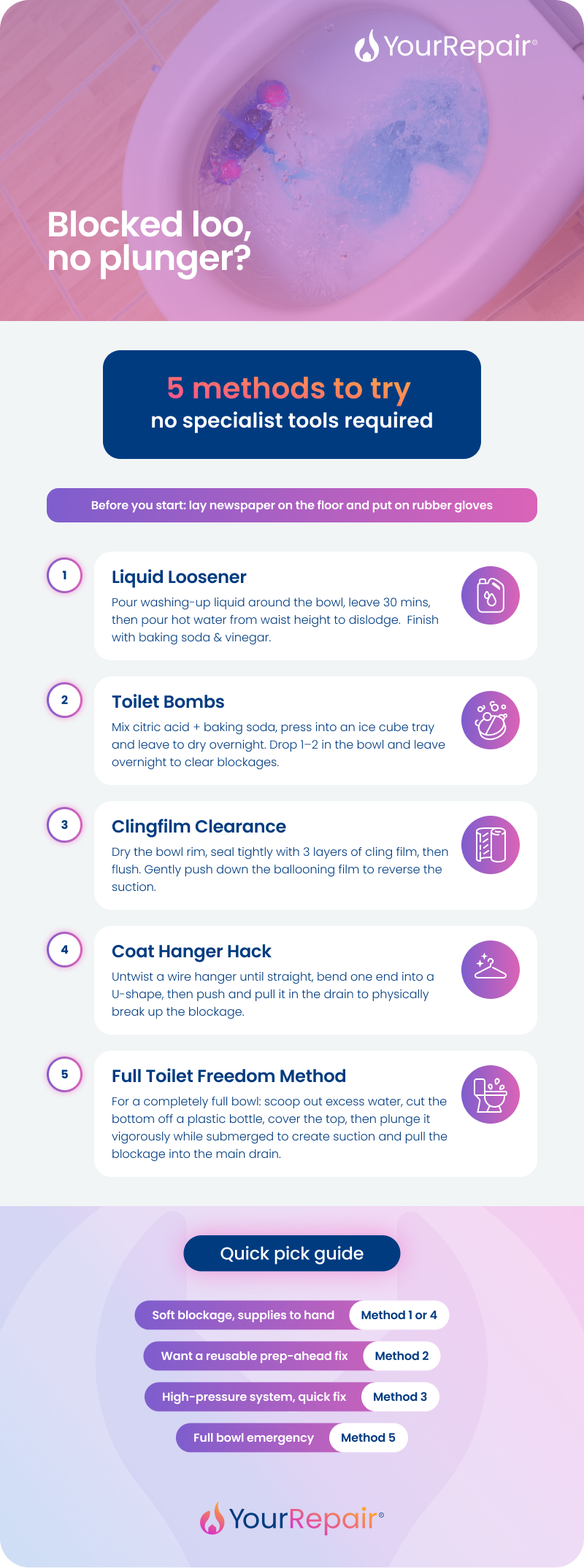
Before you start
If there is visible waste in the bowl avoid the Coat Hanger Hack and the Full Toilet Freedom Method. Both require inserting something into the bowl, which increases the risk of splashing unhygienic waste about. The Liquid Loosener (Method 1) is your safest option here. Use rubber gloves and keep the toilet lid down between steps where possible.
Before attempting any of the following hacks, we recommend you place newspaper on the floor around your WC and put on rubber gloves.
What if the toilet’s water level is too high?
If your toilet bowl is close to overflowing, you first need to prevent it from doing so.
Step 1: Stop more water entering the bowl
Lift the cistern lid and prop or tape the float arm upward. This prevents the cistern from refilling after a flush.
Alternatively, turn the isolation valve on the pipe behind or beneath the toilet clockwise until it stops. This cuts the water supply entirely.
Step 2: Remove water from the bowl
Use a container (jug, old mug, etc.) to scoop water out into a bucket. Bring the water level down to about halfway.
Step 3: Proceed with one of the methods below
The Liquid Loosener (Method 1) or the Full Toilet Freedom Method (Method 5) are your best options from a high-water starting point.
Did you know? Toilets are the single biggest user of water in the average British home, accounting for around 30% of all household water consumption. A family of four, flushing an average of 50 times a day, can use over 300 litres on flushing alone. This is enough to fill a standard bathtub three times over. Switching to a modern dual-flush model is one of the most effective water-saving improvements you can make.
1. The Liquid Loosener
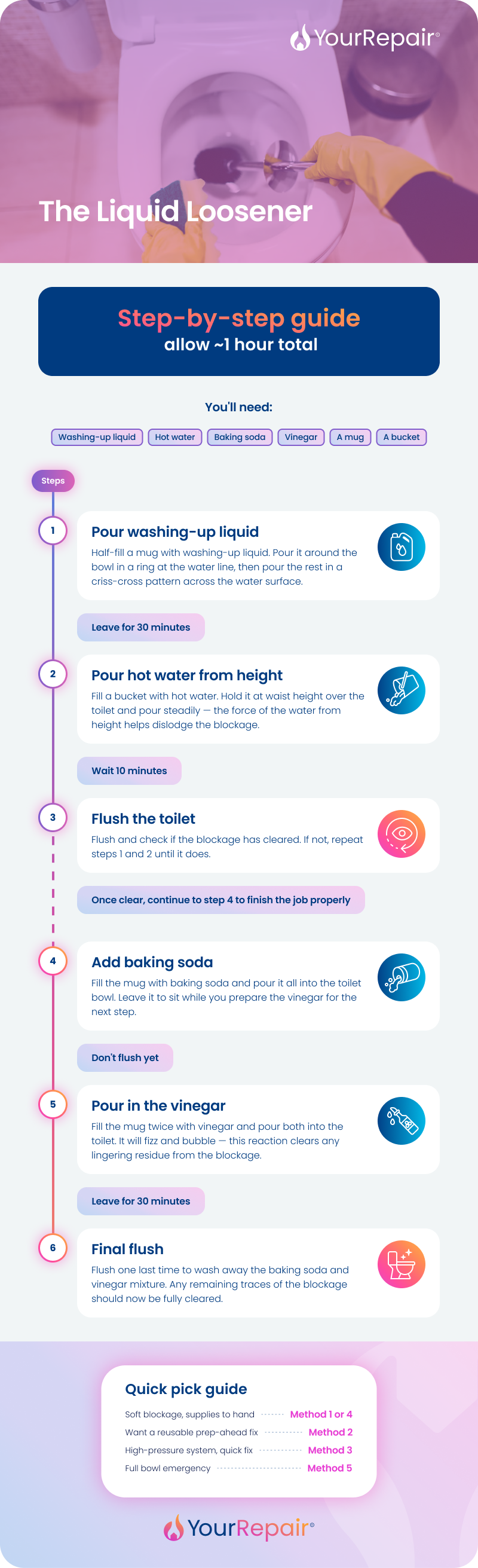
Items required
- Washing-up liquid
- Mug
- Bucket
- Baking soda
- Vinegar
Method
This is probably the best-smelling way to unblock a toilet.
Step 1: Pour out washing-up liquid
Half-fill the mug with washing-up liquid. Pour it into the toilet by letting it drip around the bowl so you get a ring around the water line.
Next, pour the rest of the liquid in a criss-cross shape across the water surface itself.
Leave for about half an hour so that the liquid can work its magic on whatever’s causing the clog.
Step 2: Pour out washing-up liquid
Fill the bucket with hot water. Standing over the toilet, hold the bucket near your waist and pour the water into the toilet.
The power of the water being poured from such a height should dislodge whatever’s blocking the toilet.
Wait about ten minutes…
Step 3: Flush the toilet
Now, flush the toilet.
Hopefully, your toilet will be back to normal. If not, repeat the process until the blockage clears.
Step 4: Baking soda
Now, it’s time to make extra sure that whatever was causing the blockage has totally gone.
Fill the mug with baking soda and pour it down the toilet. Leave it there whilst you carry out step 5…
Step 5: Add vinegar
Then fill the mug twice with vinegar and pour it into the toilet as well.
It’ll create a bubbling mixture. Leave this in the toilet for half an hour.
Step 6: Final flush
Finally, flush the toilet one last time, washing away the baking soda and vinegar mixture for good.
Any remnants of that blockage-causing item hopefully will be gone!
Did you know? As late as 1951, roughly one in three UK homes had no indoor toilet. By 1971, the figure was still around one in five. The last major survey to document widespread outdoor-only toilet use in England was conducted in 1981, but it’s likely that during that decade outdoor toilets largely disappeared.
2. Toilet ‘bombs’
Items required
- 70g citric acid
- 300g baking soda
- Water to spray
- Rubber spatula
- Ice cube tray
Method
Step 1: Mix into a single mass
Mix together the citric acid and baking soda in a bowl, then spray some water over the mixture until what’s in the bowl starts to form a single mass (it only takes a little water, so don’t spray too much otherwise it will start to bubble).
Step 2: Place into ice cube tray(/s)
Scoop the mixture out of the bowl with the spatula and press it into the individual ice cube trays.
You can add fragrance to the mixture to make it smell nicer if you want to but either way, you need to leave it overnight to dry out.
Step 3: Drop into the toilet
The next day, you’ll have lots of little square toilet bombs which you can use to unblock your toilet.
You only need to drop one or two into your toilet bowl in the evening and leave overnight to clear any blockages.
You can store the rest in a jar in your bathroom and use them when you need them.
Toilet myth! The Victorian plumber Thomas Crapper did not invent the modern toilet (although he did exist and popularise the ballcock valve). The actual inventors were centuries before, Sir John Harington (1596) and Alexander Cumming (1775). who pre-date Crapper by generations. The word "crap" also predates him by centuries. So his name, which has made the myth memorable, is merely a coincidence!
3. Commercial toilet unblocker liquid
Items required
- Rubber gloves
- A commercial toilet unblocker (available from most supermarkets)
Method
If DIY the above methods aren't removing the blockage, commercial toilet unblocker liquids are worth trying.
Products with sodium hydroxide (caustic soda) or hydrochloric acid are designed for toilet and drain blockages.
Pour the amount stated on the packaging into the bowl, leave for the recommended time (usually 15–30 minutes), and then flush.
A few rules before using commercial toilet unblockers:
- Never mix different chemical products. Combining bleach with caustic soda or acid can produce toxic fumes.
- Keep the bathroom ventilated. Open a window before you start.
- Don't use in a full bowl of water. The product will be too diluted to reach the blockage and follow the high water level steps above first
Consider an enzyme-based alternative. These are labelled as "bio" or "enzyme" unblockers, are safer for PVC pipework, and won't produce fumes. They work more slowly but are the better choice for softer organic blockages.
4. The Clingfilm Clearance
Items required
- An old towel
- Cling film
Method
Before you start, you need to know that the cling film clearance method works best with high pressure water systems.
If yours is low pressure, or you don’t know what the pressure level is, this might not be your best option.
Step 1: Checks & flush
To begin, roll-up your sleeves and check the surface of your toilet bowl is dry because you’re going to be covering it with three layers of cling film.
Make sure it’s firmly in place over the porcelain so your toilet is air-tight. Then flush.
Step 2: Push down clingfilm
What happens next should be pretty impressive. The cling film will balloon upwards because of the pressure caused by the flush.
All you need to do is gently push down on the cling film to reverse the suction and clear the blockage.
5. The Coat Hanger Hack
Item required
- Wire coat hanger
Method
This one is easy but, for the best results, use in conjunction with The Liquid Loosener (see above).
To begin with, you’ll need to untwist your coat hanger until it’s straight.
Then bend one end to form a U-shape. Push and pull this end in and out of the toilet to break the blockage up so that it can flow away.
6. The Full Toilet Freedom Method
Items required
- Plastic bottle
- Scissors (to cut the bottom off the bottle)
- A small container
- Rubber gloves
- Old clothes
Method
Start by cutting the bottom off a plastic bottle. Put it to one side for a minute.
Carefully scoop some of the water out of the toilet bowl using a small container.
Pick up your plastic bottle. Either put the lid on it or hold your thumb over the top to cover the hole.
Lower its open end into the toilet bowl and then thrust it up and down vigorously.
It should be just like you would if you had a plunger handy (but you don’t, remember, that’s why you’re holding half a plastic bottle!)
Ensure the bottle remains submerged in the toilet bowl water throughout.
It will create the vacuum required to suck the blockage back into the main drain.
Did you know? Before modern sewers, British homes disposed of waste into pits dug beneath or beside the property called cesspits. When full, they were emptied by night soil men, who collected the waste after dark and sold it to farmers as fertiliser. (Their insight into the nocturnal happenings of cities meant that some of them were even used as informants for spies and the police.) As cities grew, cesspit infrastructure often couldn’t keep pace and was often linked to contamination and disease (especially cholera outbreaks). In London, where there were approx. 200,000 cesspits, The Great Stink of 1858 finally forced Parliament to order the building of a modern sewage system.
What to do next
Once the blockage is cleared, you may notice drain smells.
This is a sign that waste has built up in the pipework and needs flushing through.
A persistent blockage may indicate a deeper plumbing problem in your waste pipe.
Read: How to Unblock Your Kitchen Sink — 6 Methods That Work
Home emergency cover with YourRepair
Shield your home from costly and unexpected disasters with YourRepair's home emergency cover.
Enjoy peace of mind and don't face a home emergency alone again. T&Cs apply.