

Smart Thermostats UK: Control Your Heating & Cut Bills
For most of the UK's history, keeping a home warm meant building a fire and feeding it by hand.
In the last hundred years, it’s moved from open flames to gas boilers to programmable timers.
Each step has given homeowners more control and efficiency.
Smart thermostats are the latest chapter in that story.
Smart thermostats: An overview
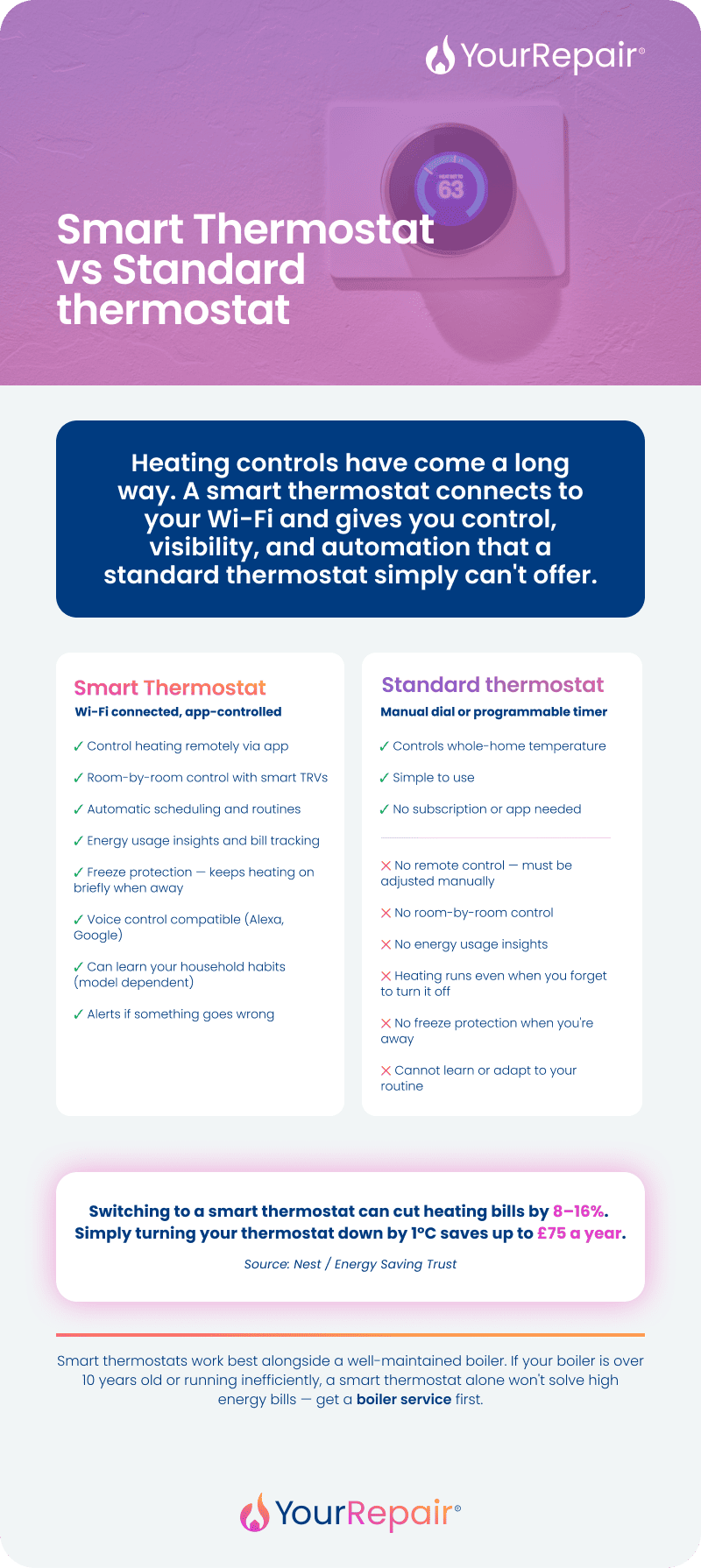
A smart thermostat is a heating control device that connects to your home’s Wi-Fi.
It enables you to control and monitor your heating remotely (via an app).
Instead of one dial for the whole home, you often get:
- Room-by-room control
- Automatic scheduling
- Insights into your energy usage.
Smart homes
Smart thermostats are a key component of smart homes, homes with internet-connected devices to control things like light, sound, security, or temperature.
In addition to giving you full control via an app or your voice, these devices offer monitoring, automation, and smart predictions.
They reduce guesswork and manual tasks in your daily life.
How does a smart thermostat work?
A smart thermostat uses a boiler-communication loop to manage your home's temperature.
First, it collects real-time data, such as room occupancy (from sensors) and local weather forecasts (the internet).
Next, its algorithms process this data to decide if and when heating is required. Finally, the thermostat sends a digital signal to your boiler to adjust its output.
This process relies on four key features:
- Modulation: Instead of running your boiler at 100% capacity, modulating thermostats adjust the boiler's flame size. This matches a room’s heat loss, which prevents wasted energy.
- Scheduling: This lets customise the times when you want or don’t heating.
- Learning: Many smart thermostats automatically track your daily routines. They use algorithms to build a schedule for you without any manual input.
- Zoning: This allows you to control the temperature room by room. You can do this by pairing your thermostat with smart radiator valves.
Boiler, Radiators, & More with central heating cover Get Covered
1. Heating an empty house
Turning the (regular) thermostat down before you leave home is a key energy-saving action.
However, things don't always go according to plan. Wasted heating might be caused by:
- Forgetting to turn off your radiator manually
- Unpredictable daily work schedules
- The kids leaving the heating on in empty rooms
There are other potential causes, too. But let's move onto the solutions.
2. Hidden energy inefficiencies
If there isn't any visibility into your power usage, it’s difficult to understand how best to lower your energy bills.
After all, energy is often treated as an unseen operational cost until the utility bill arrives.
If your bills are unexpectedly high, check that:
- You don't have "phantom power" draining your circuits
- Your radiators aren't balanced
- Your HVAC equipment isn't running inefficiently or nearing failure.
You might simply need to bleed your radiators or even get a power flush. But rather than wait until it's cold to do these, you could anticipate them sooner with a smart thermostat.
If it turns out you have no idea where the power is going, move onto the fix…
3. Burst pipes in winter
A frozen pipe that bursts is one of the most disastrous things that can happen in a home.
Water is often treated as a fixed utility cost until a hidden leak causes problems.
Smart thermostats can consistently turn the heating on briefly.
It helps prevent frozen pipes if, for example, you are away on holiday during the winter.
Mmart water leak detectors (like those from Zooz or Shelly) also have a smart shutoff valve on your main water line.
This prevents serious water damage (and expensive repair costs).
4. Managing complex HVAC systems
Smart thermostats can manage radiant cooling, complex HVAC setups, and DIY manifold control (unlike regular thermostats).
This helps you maintain a consistent home temperature for optimal comfort.
Fixing complex heating controls
If you cannot quickly see how to connect all your heating systems, you will need to centralise your controls.
Using a local hub like Home Assistant allows you to build actionable dashboards and tie all your climate data together.
If coding sounds intimidating, you can even use AI tools like GitHub Copilot to help you write the automations for your complex heating setups.
Read: Heating Engineer vs Plumber — Which One Do You Need?
5. Voice commands for smart thermostats
We all know those situations when we are too warm and/or tired to want to get up and manually change the thermostat...
Fortunately, most smart thermostats pair easily with popular smart speakers, which lets you control your home's temperature with voice commands.
However, there are often differences in what you can do by voice versus what requires the app.
Voice versus app parity
Voice commands usually work for simple adjustments. For example, "turn the heating up by two degrees."
But more complex ones still require smartphone apps. For instance, you can’t usually edit heating schedules or view energy usage reports using your voice assistant.
Safeguards and permissions
A common concern for parents is children shouting at a smart speaker to turn the heating off in the middle of winter.
So, most smart assistants allow you to set up specific safeguards. Features like PIN locks or guest voice restrictions ensure only authorised voices can alter the temperature.
Overrides and interface syncing
If you use a voice command to override your schedule, this change should sync with your interface display and app.
Well known smart thermostats (UK)
Hive’s V4 and Mini smart thermostats: 4/5 (recommended)
Recent models in Hive's latest smart thermostat lineup include the full-size V4 and budget-friendly Mini variants.
The V4 boasts a sleek, modern redesign. It’s smaller, unobtrusive, and finished with a smart black glass face and silver dial.
The Mini has no physical dial. It’s a flat, mirrored touchscreen that blends seamlessly into contemporary decor.
And - like the V4 - is relatively simple (and fast) to install.
Both models pair an intuitive companion app with reliable performance.
Reviewers particularly praised the standout "Heat Boost" multi-room zone heating features. It also has advanced features, such as:
- Bill tracking
- Predictive savings
- Detailed energy budgets
However, these require a Hive Plus subscription (£3.99/month). On the negative side: Unlike AI-driven rivals (such as Nest), Hive doesn't learn your habits automatically. Schedules must be set manually.
Nest Learning Thermostat (3rd Gen): 4/5 (recommended)
The latest officially available Nest smart thermostat model for UK consumers is the Nest Learning Thermostat (3rd Generation), which continues to be sold while stocks last.
(In the US market, there is a 4th generation model. However, this isn’t compatible with a lot of UK and European heating hardware.)
It has a visually exciting jewel-like premium aesthetic and an intuitive rotating dial.
Its intelligent learning algorithm tracks household routines to cut heating bills by 8% to 16%.
It also provides dedicated hot water cylinder control and supporting OpenTherm modulation. These help modern boilers run more efficiently.
However, it lacks some modern smart home features.
For example, it has no multi-room zonal control via smart radiator valves (TRVs).
And it requires some relatively complex wiring for installation.
Central heating cover from YourRepair
Unexpected heating breakdowns can happen. Get protected today with central heating cover from YourRepair. T&Cs apply.