

How to Unblock Your Kitchen Sink — 6 Methods That Work
Stagnant dishwater in the kitchen sink is not just a bad sight (and smell!).
It’s also unhygienic.
Read on to learn how to tackle this common problem.
Southern Water estimates more than 3,000 UK homes are flooded every year specifically because of fats, oils, and grease being washed into sewers. And Thames Water handles 85,000 blockages a year across its service area alone.
What causes a sink blockage

There are three common causes of blocked kitchen sinks:
- Fats, oils, and grease (FOG): Don’t pour these down the drain when they are hot. When they cool, they can solidify onto the pipes.
- Soap scum: When soap comes into contact with minerals in your tap water, it leaves behind soap scum. This builds up in your pipes and can trap food debris.
- Food debris
It’s a mix of more than one and the build up happens gradually over time.
Sometimes you can tell there’s a building by the bad smell from your kitchen sink (even before water has stopped flowing through it).
Why Does Your Kitchen Sink Smell? (& How to Get Rid of It)
Wider issues
Some blockages are caused by wider plumbing issues, such as outside pipe blockages/damage or incorrect sink installations.
These are often difficult to diagnose without the help of a professional.
However, some signs you can look out for are:
- Recurring blockages or slow draining of sinks
- Multiple sinks in your home being blocked at once
- Toilets not flushing or making gurgling sounds
- Strong sewage smells nearby outside drains.
If you notice any of these, get in touch with a professional plumber.
And if unblocking the sink reveals damaged pipework, you may have a water leak that needs immediate attention.
Most people clean their toilets more regularly than their sinks, but research has found the latter contains around 100,000 times more bacteria per square centimetre than a toilet seat! This can include E. coli and Salmonella, often transferred from raw meat and unwashed vegetables. The basin is typically worse than the drain, but a weekly clean with antibacterial sprays is usually enough to keep bacterial levels in check.
Initial signs of a blockage: a slowed down sink
First, you should determine if the flow of water in your sink has slowed down or stopped entirely.
If the water is moving slowly, this suggests a build-up of debris in your pipes.
This can often be fixed using one of the following methods.
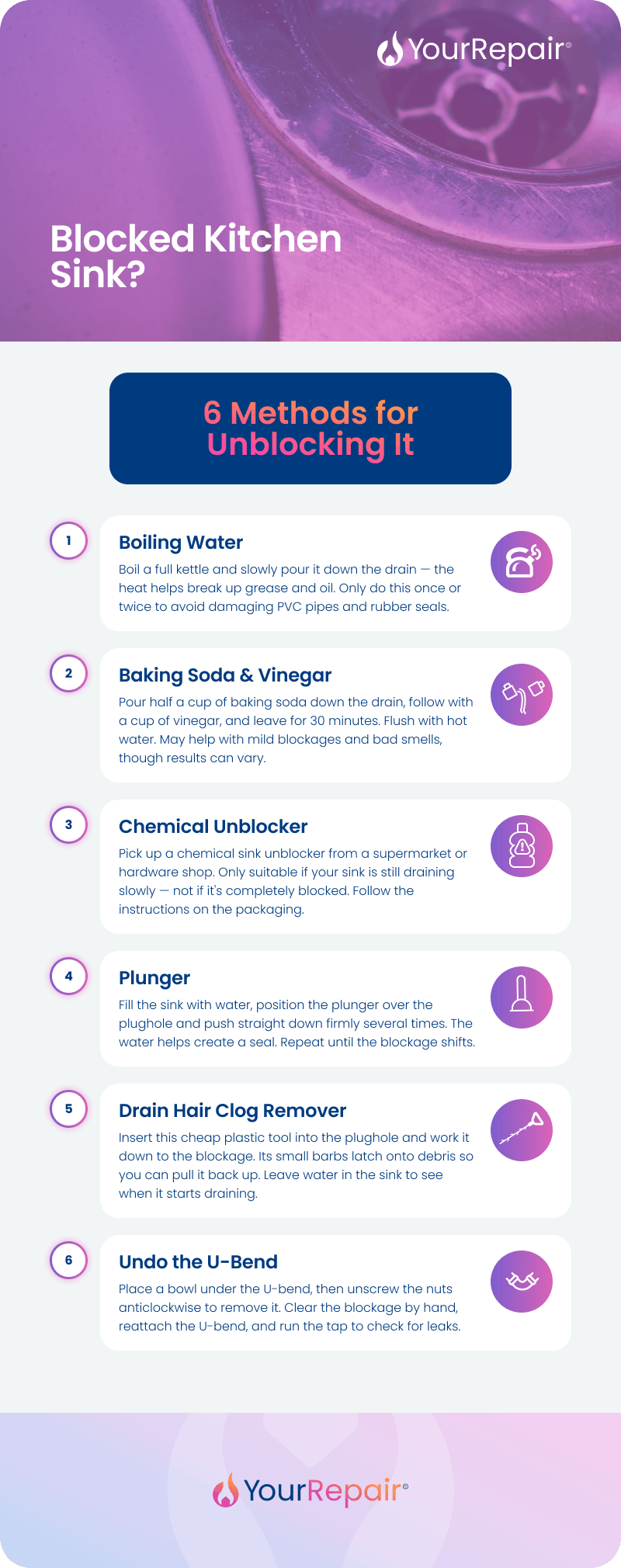
Boiling water
This is a simple and inexpensive way to unclog your sink drain.
If the blockage is caused by oil or grease, the heat will help to ease it away.
Boil a full kettle and slowly pour all the water down the drain.
Be careful not to splash yourself.
Only do this once or twice though.
Most UK kitchen sinks have PVC pipes and rubber seals which will be damaged by repeated pouring of boiling water.
Did you know? Before modern drainage, wastewater went into a bucket that was emptied into the street, often into open channels called "kennels". By the 18th century, cities had cesspits, but most wastewater still drained into rivers. In London, the Thames basically became an open sewer until Joseph Bazalgette’s underground sewerage network in 1875. Before that, the river smelled so bad during summer that Parliament regularly abandoned its sessions.
Baking soda (bicarbonate of soda) & vinegar
Allow the sink to drain as much as possible and then pour half a cup of baking soda down the drain (bicarbonate of soda, not baking powder).
Follow this with a cup of vinegar.
The mixture will fizz up.
Leave it to sit for at least 30 minutes and then flush the pipe with hot water from the kettle.
This might clean out any debris and also help to neutralise bad smells.
However, take note: although some homeowners swear by this method (some even use it to unblock toilets without plungers), many plumbers believe it’s unreliable!
Chemical plughole unblockers
Most supermarket cleaning sections and hardware shops have chemical sink unblocking products.
These are not suitable if your sink is filled with water.
They only work if you are able to get at least some liquid into your plughole, i.e., if it’s draining slowly and not totally blocked.
Follow the instructions on the packaging to unblock your plughole. Most will guide you through something along the lines of:
- Pour into the plug
- Wait 5 - 10 minutes
- Turn the tap on gently/slowly to see if the blockage has gone.
Most chemical drain unblockers work by using sodium hydroxide (caustic soda) to dissolve blockages. When it reacts with water and generates significant heat, some products reach temperatures above 80°C inside the pipe. Most UK kitchen pipework has used PVC since the 1970s, which begins to soften and warp at around that temperature. So, used occasionally, chemical unblockers are ok. But used repeatedly, they cause damage by degrading pipes and softening seals.(& How to Get Rid of It)
A completely blocked sink
Plungers
If the water is not moving at all, you may need to reach for the plunger to get the water flowing again.
Plungers need a sink full of water to create a seal.
Before plunging, block the small opening near the top of the sink basin (the overflow hole) with a wet cloth. This seals the drain, which gives the plunger stronger suction.
Then, position the plunger over the plughole and push straight down a few times.
Finally, remove it and see if the water has started to drain. Do this a few times to try to push the blockage down the drain.
Drain hair clog remover
If you cannot unblock your kitchen sink with a plunger, try using a drain hair clog remover.
This flexible, and relatively cheap piece of plastic has small barbs.
The barbs are designed to latch on to blockages and allow you to pull them back up the drain.
Once you’ve inserted it into the plughole, it should be able to work its way around the U-bend easily.
When you reach the blockage, try to dislodge it.
Leaving water in the sink as you do this will show you if the blockage has shifted as it starts to drain.
After removing the blockage, try one of the methods above to clear any remaining debris from the pipes.
Drain snake (plumber's auger)
For deeper blockages, drain snakes are better than hair clog removers. You can buy these online or in hardware shops for around £10–20.
Push the coiled end down the plughole. When you hit resistance, rotate the snake then pull it back.
Your goal is to break up or hook the blockage. Afterwards, run hot water to flush away remaining debris.
Undo the U-bend
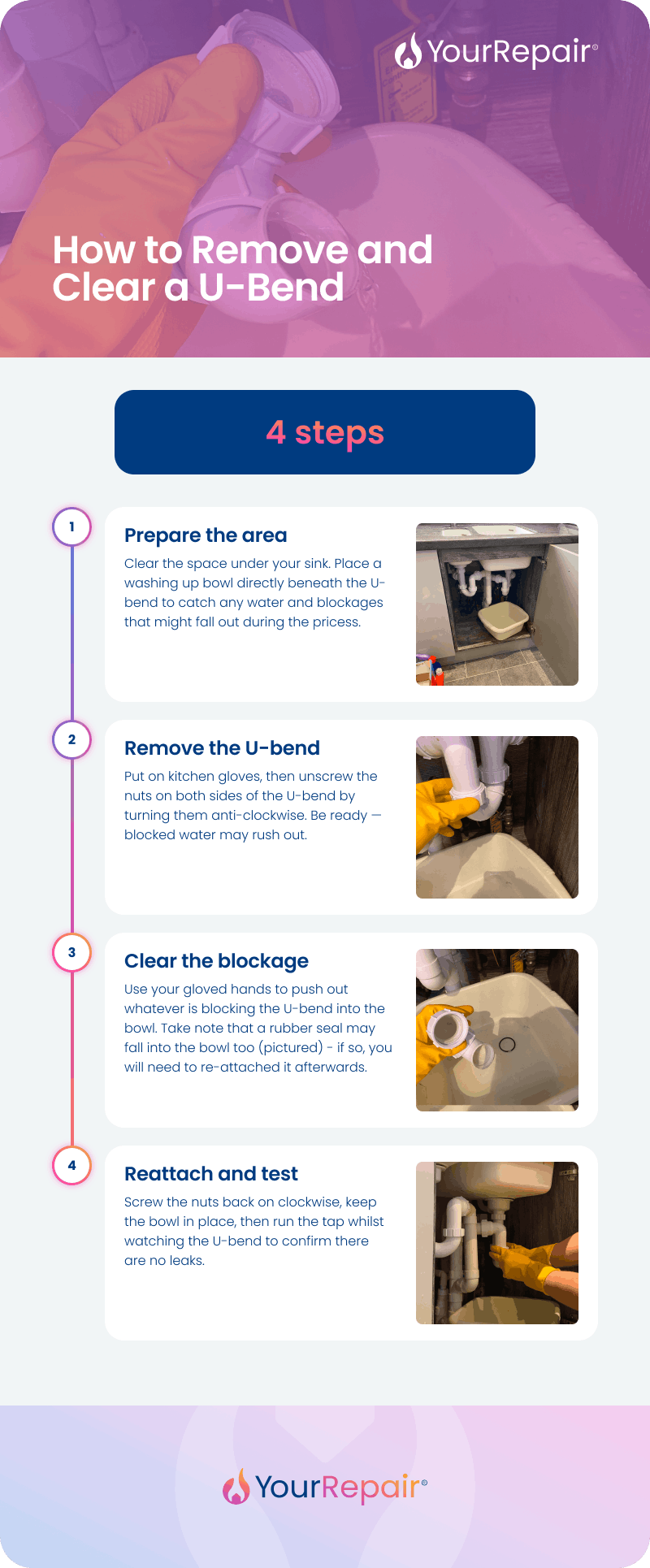
First, clear the space under your sink and place a washing up bowl underneath its U-bend.
Next, wearing kitchen gloves, undo the U-bend by turning the nuts on both sides anticlockwise.
Once the U-bend is fully loosened, previously blocked water may rush out and into the washing up bowl.
Now, use your (gloved) hands to push out whatever is blocking the U-bend (into the bowl).
Once this is done, put the U-bend back on (turn the nuts clockwise) but keep the bowl there.
Run the tap to double check the U-bend is on properly.
If it is, the job is done.
How to Clean Kitchen Appliances (& the Mistakes That Could Be Making Things Worse)
Tried everything and the sink is still blocked?
If none of the above has worked, the blockage is likely either:
- Deep in the waste pipe beyond the U-bend
- A hardened fat deposit that requires a chemical solvent
- A sign of a wider drainage problem (a shared soil pipe or outside drain blockage).
At this point, call a plumber. Attempting to dismantle pipework beyond the U-bend without experience risks leaks and damage.
Home emergency cover with YourRepair
Shield your home from costly and unexpected disasters with YourRepair's home emergency cover.
Enjoy peace of mind and don't face a home emergency alone again. T&Cs apply.