

How to Thaw a Frozen Boiler Condensate Pipe — Safely and Without an Engineer
A boiler rarely stops working at a convenient time.
But cold weather is the worst time of all.
Unfortunately, this is when a frozen condensate pipe is most likely to happen.
Fortunately, you can easily fix it yourself without calling a heating engineer.
Read on to learn what a condensate pipe does, how to thaw it, and how to prevent it from freezing again.
What condensate pipes are exactly
Modern condensing boilers produce wastewater.
(Most types of boilers in the UK come under the condensing category.)
The condensate pipe safely carries this wastewater away from the boiler and down into an outside drain.
Because these pipes usually run down the outside of your property, they are highly vulnerable to freezing.
This creates a blockage that forces your boiler to shut down.
Identifying the problem
In general, knowing what sounds your boiler makes normally is the secret to catching issues with it early.
If it’s cold outside and your boiler shuts down and makes a gurgling noise, the condensate pipe might be frozen.
However, there are other signs of a frozen pipe, including:
- Check for an error code: Most modern boilers display a fault code when they stop working. Cross-reference it with your boiler manual, there will likely be a specific code for a condensate blockage.
- Inspect condensate pipe: Once you’ve located the pipe (see below), look for visible ice around the pipe or at the point where it drains (a clear sign it’s frozen). Feel the pipe, too. If it’s frozen, it will feel solid rather than hollow.
- Check for water flow: No drips or trickles of water could be a sign it’s frozen.
How to thaw a condensate pipe (3 Simple Steps)
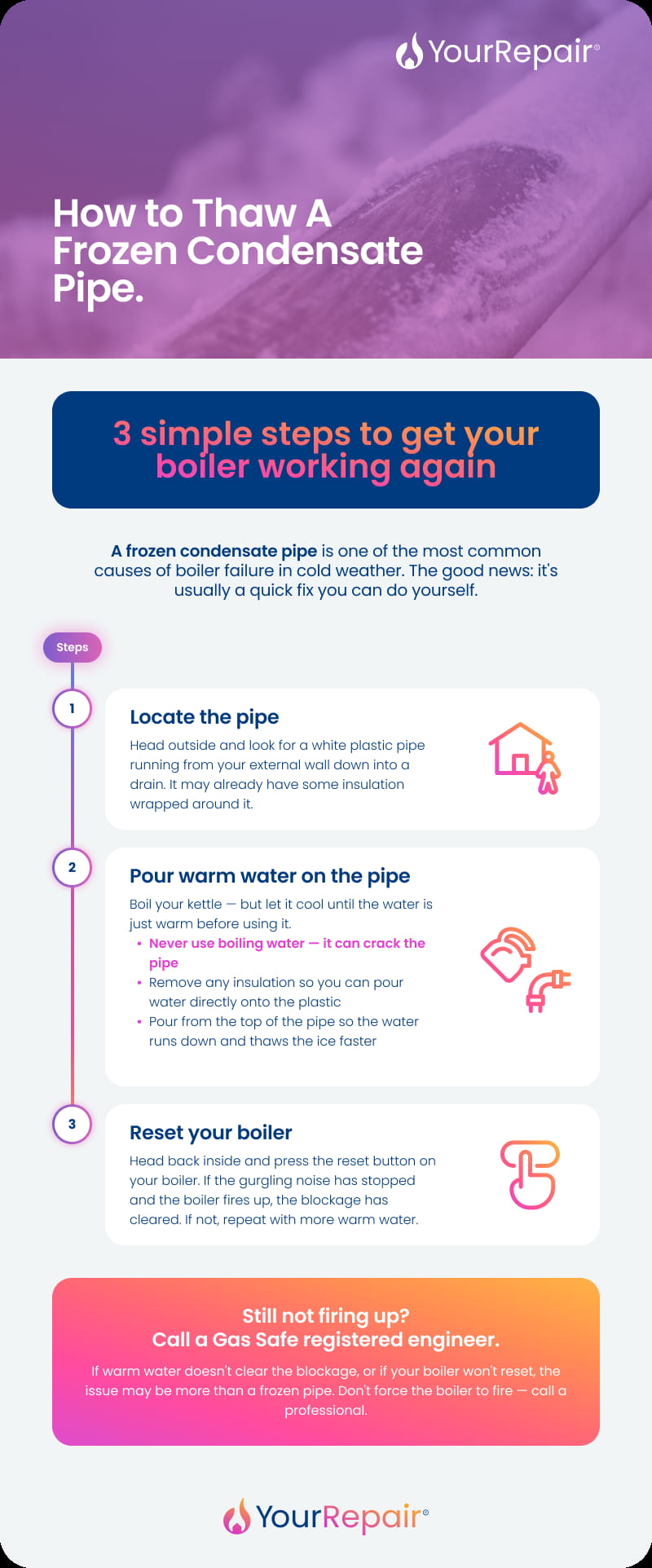
1. Locate the pipe
Head outside and look for a white pipe running from your external wall down into a drain. It may already have some insulation wrapped around it.
2. Pour warm water on the pipe
Boil your kettle, but let it cool until the water is just warm.
- Never use boiling water, as it can crack the pipe.
- Remove any insulation so you can pour water directly onto the plastic.
- Pour the warm water starting from the top of the pipe so it runs down and thaws the ice faster.
3. Reset your boiler
Head back inside and reset your boiler.
If the gurgling noise has stopped and the boiler fires up, you have successfully cleared the blockage.
If not, repeat the process with more warm water.
Preventing future freezes
Preventative maintenance is the only way to keep your boiler out of emergency mode.
Ignoring minor flaws—like a tiny gap in badly fitted insulation—increases the chance of a boiler shutdown when the next cold snap hits.
To stop your pipe from freezing, you should:
- Upgrade your insulation: Standard DIY foam from a hardware store helps, but investing in dedicated, professional-grade external pipe insulation is far more effective.
- Retrofit your system: Smart upgrades pay for themselves in long-term reliability. Ask a plumber to upgrade your pipe to a much wider 32mm to 40mm diameter, which is much harder to freeze.
- Adjust the angle: Ensure the pipe is incredibly steep. Horizontal sections collect pooling water, which quickly turns to ice.
- Reroute internally: If you are installing a new boiler, simply ask your engineer to route the majority of the pipe inside your home so it stays warm.
And, of course, an annual boiler service is the key to keeping your boiler working efficiently and lasting a long time.
How boiler cover can help
While thawing a condensate pipe is a quick DIY fix, other winter breakdowns are much more severe.
Without boiler cover, you could end up paying a fortune for unexpected emergency repairs.
At YourRepair, we offer comprehensive home and boiler cover plans to keep you in control.